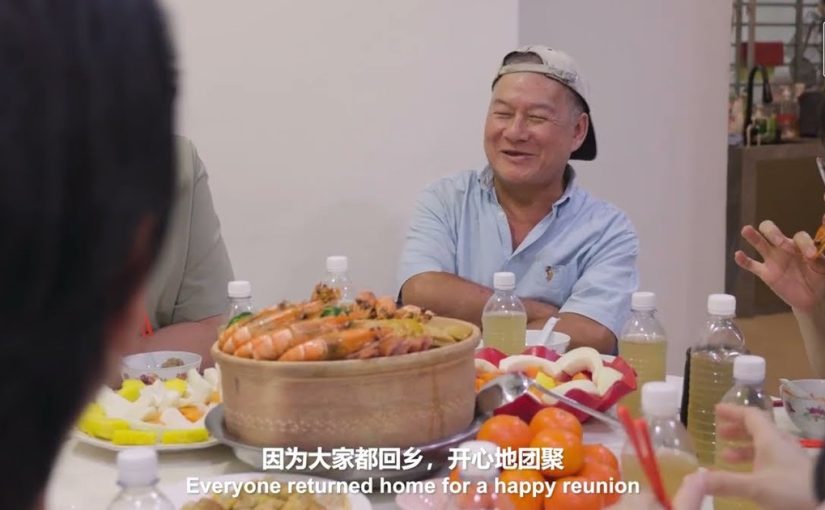
Poon Choi (also known as Basin Feast) is a traditional Hakka festive dish, with over a dozen ingredients stacked layer by layer inside a metal basin or claypot, full to the brim, symbolizing prosperity, as well as family reunion.
The ingredients used in Poon Choi are according to one’s means, and vary with regional or personal preference. The making of Poon Choi may seem simple, but the preparation process is complicated, time-consuming, and laborious. The dozen ingredients are cooked using various methods such as stuffing, pan-frying, deep-frying, roasting, boiling, braising, stewing, and blanching, comparable to preparing a banquet. The broth is the essence of Poon Choi. When poured over and heated, it penetrates layer by layer. The further down the ingredients are in the pot, the more fully they absorb the broth, therefore the more flavorful.
At 5AM, in a home kitchen in Semenyih, Uncle Wee Boon Kim makes a broth with pork bones and an old hen. He insists on using whole ingredients to make the broth and does not use MSG, which makes the broth taste delicious. During the six hours it takes to simmer the broth under low heat, instead of being idle, he washed, chopped, and processed other raw materials.
Firstly, he makes stuffed dried oysters, stuffed gluten puffs, and jumbo pork meatballs. Jicama and carrots are sliced into strips, fresh fish and minced pork are hand-beaten into a paste. These materials form the base for hand-rolled stuffed fillings and meatballs. Dried oysters are steamed and cut to make stuffed dried oysters, whereas round gluten puffs are slit in the middle to insert stuffed fillings. Marinated pork ribs are pressure-cooked, then braised together with yam chunks. Next, he blanches the four-month-old free-range chicken raised by nearby farmers, as well as broccoli. Then the prawns are deep-fried until golden. Rehydrated mushrooms, sea cucumbers, and fish maw, along with ready-to-eat smoked duck and abalone, are all set aside for later use.
Take a claypot about one foot in diameter and half a foot deep, line the bottom with Chinese cabbage, white radish, and mushrooms, all of which are resistant to stewing and have excellent absorption capacity. The middle layers are filled with minimally processed ingredients such as stuffed dried oysters, stuffed gluten puffs, jumbo pork meatballs, braised pork ribs with yam, poached chicken, and smoked duck. The top layer is made up of expensive ingredients such as abalone, sea cucumber, fish maw, and fried prawns, garnished with broccoli. Pour the broth over and steam to reheat, a lavish dish is thus completed.
Uncle Wee does not make Poon Choi year round, he only accepts bookings for Chinese New Year’s Eve. He has 35 years of experience doing banquet catering in restaurants, working his way from commis up to the main chef, where he mastered the art of Cantonese cuisine. Originally a Hainanese, Uncle Wee settled in Semenyih due to work, and married a Hakka wife. During the MCO, he was out of a job, so he tried selling Poon Choi as a side hustle. Because of its delicious taste made using high-quality ingredients, customers have been repurchasing it for several years and have also recommended it to their relatives and friends.
The Poon Choi by Uncle Wee is only available for pickup in Semenyih. After a quick steaming at home, it becomes a sumptuous Chinese New Year’s Eve dinner. The whole family gathers around the table for a meal, savoring the delicious flavors and cherishing the warm atmosphere of the Chinese New Year. Apart from meat-based Poon Choi, Uncle Wee also makes vegetarian Poon Choi. The broth is made with white radish, Polygonatum odoratum, and Polygonatum macropodium, and all the meat ingredients are replaced with vegetarian ones. Uncle Wee also accepts pre-orders for classic festive dishes such as Eight Treasure Duck, Phoenix Balls, and Pearl Rolls, each of which requires meticulous culinary skills to prepare.
On Chinese New Year’s Eve, share a sumptuous Poon Choi at the reunion dinner with family and friends. The joy of gathering and the beautiful hopes for the future are all gathered in this delicious dish.
※※※
【The Origin of Poon Choi】
There are many theories about the origin of Poon Choi, but none can be verified. Two of the more popular theories are:
(1)
Wen Tianxiang, a loyal minister and national hero of the Southern Song Dynasty, was defeated by the Yuan army and retreated to the Shenzhen area. The local boatmen, both admiring and sympathetic to Wen Tianxiang and his troops, cooked pork, radishes, and freshly caught fish and shrimp from their boats for the soldiers. Because there were limited bowls and plates on the boats, the food was served in wooden basins. After the defeat, many people settled in the area (including Wen Tianxiang’s descendants), forming the Hakka people.
(2)
During the late Southern Song Dynasty, Emperor Zhao Bing and his officials fled south to escape the Yuan Dynasty army. When they passed through one of the walled villages in the New Territories of Hong Kong, they were warmly received by the villagers. In their haste, the villagers could not find enough containers for the food. In order not to waste everyone’s good intentions, they used wooden basins to hold the dishes, and everyone sat around the basins to eat. The best ingredients were placed on top and presented to the emperor.
※※※
【Poon Choi Info】
Poon Choi is one of the most representative festive dishes in Hakka cuisine. It is an essential dish for Hakka people during important occasions such as religious rituals, major festivals, and weddings. In the past, it was also called “Hundred Birds Paying Homage to the Phoenix.” Because Poon Choi contains a wide variety of ingredients, the combination of flavors and seasonings is very important, and the cooking time must be just right. When eating Poon Choi, one should eat it layer by layer from top to bottom, so that good fortune rolls in from the tip of the tongue. The minimum serving size for Poon Choi is 6 people, and modern restaurants generally offer 10 servings.
The core of Poon Choi is its broth, and each family has their own secret recipe. The most distinctive feature of Poon Choi is that it incorporates various cooking methods such as frying, deep-frying, braising, boiling, stewing, and simmering within this “bowl of treasuresl.” The top layer of Poon Choi usually contains the most precious ingredients, the middle layer contains minimally processed ingredients, and the bottom layer is generally raw vegetables, which are more resistant to stewing and absorb the broth until they are soft and flavorful.
※※※
【Auspicious Meanings in Poon Choi】
Here’s a compilation of some interesting interpretations of the auspicious meanings in Poon Choi from the internet, just for fun:
- Mushrooms – success in all directions
- Meatballs – abundant wealth
- Dried Oysters – good fortune/prosperous returns
- Stuffed Gluten Puffs – the best of both worlds
- Chinese Cabbage – financial prosperity
- Poached Chicken – good fortune and surplus
- Braised Pork with Yam – family happiness
- Abalone – wealth and prosperity year after year
- Broccoli – youth, beauty, and good fortune
- Prawns (homophone for “laughing heartily”) – constant happiness
- Sea Cucumber (homophone for “deep sea”) – boundless blessings
- Duck (take the radical “甲”) – academic success and achievement
- White Radish (translates to “vegetable head” in Cantonese, homophone for “lucky”) – good fortune
- Fish Maw – wealth and good luck
- fill the bowl to the brim – boundless wealth
有你 UNI Production
Producer : Daniel Lim
Cinematographer : Amelia Lim / Michael Lerk
Drone : Daniel Lim
Video Editor : Michael Lerk
Copywriter : Pua Hui Wen
COPYRIGHTS 2026 ECHINOIDEA SDN BHD
