Flag Maker: Khoo Koh Leong

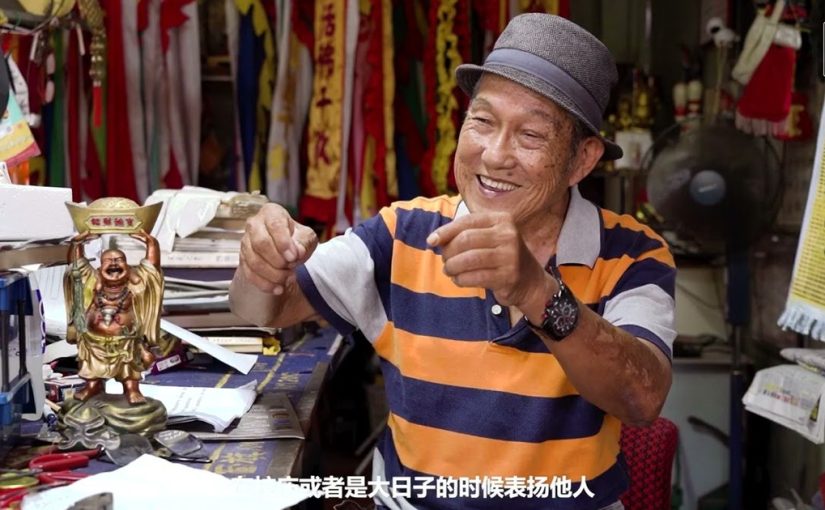
Nested within a sky-blue wooden house in Tampin New Village in Negeri Sembilan, with festive couplets adorning the doors and windows, and a wooden plaque hanging above the entrance, is Koh Leong Handicraft Workshop. Upon entry, most of the hall is taken up by a massive workbench with various tools scattered around. The room on the left holds a rectangular table over ten feet in length, hanging near the wall are all sorts of colorful cloth; the room on the right acts as a sewing room, semi-completed pieces hang aside. Uncle Khoo Koh Leong measures cloth with a wooden ruler, draws an outline with chalk, and then trims the edges. He single-handedly produced elegiac banners, appreciation pennants, and prayer flags for almost half a century.

Elegiac banners, appreciation pennants, and prayer flags all belong to the same branch of craft, however each serves a different purpose. Elegiac banners are hung in memorial halls and hearse carriages, as well as representing hometown guilds or schools to offer condolences to the bereaved family. Appreciation pennants acknowledge individual contribution towards society, commonly featuring yellow text on a red background fringed with tassel. Prayer flags are used for adornment during deity birthdays, an offering from worshippers as gratitude for blessings bestowed, showcasing divine powers, the colors vary with each deity. 

In the 1950’s, elegiac banners were handwritten on white paper, with an elegy dedicated to the deceased person and the name of the sender or association written in black ink, usually burned after the funeral service. Back then, infrastructure in Tampin were not quite developed, Uncle Khoo who was a taxi driver used to help fellow villagers in handling elegiac banner purchases from cities such as Seremban or Melaka. In the long run, Uncle Khoo began to take an interest, therefore he started his side job as a self-taught craft maker.

As living standards improved in the 60’s and 70’s, fabric elegiac banners with common obituary phrases such as “Rest in Eternal Peace” or “In Loving Memory” flourished due to convenience and reusability, as they can be retrieved by the represented association after the funeral service. A casket store owner who was friends with Uncle Khoo once enlisted his help to produce elegiac banners and couplets for memorial hall decoration, thus establishing Uncle Khoo’s reputation as well as opening up opportunities. Uncle Khoo also took on new challenges such as producing appreciation pennants and prayer flags, his highly satisfactory handiwork was sought after by customers near and far, from Tampin to the states of Negri Sembilan, Melaka, Selangor, Pahang, and even overseas from Singapore and Indonesia.

For custom flag orders, the purpose, color, and size must be confirmed as Uncle Khoo needs to source materials and cut according to the approximate outline. Upon agreeing on the appropriate text, he measures their respective sizes and copies the words onto paper. The declining traditional practice of embroidery is not feasible for Uncle Khoo, therefore he imprints the words onto the fabric, cuts and pastes them onto the flag, then waits for the glue to dry before sewing. Due to the complicated structure of Chinese words, the sewing process requires attention to details, hence each flag takes two to three days instead of overnight to complete.

Lately, Uncle Khoo switched from using calligraphy to printed words on flags, yet he persists in handcrafting. Each stitch conveys the close relationship between association members or the fervour of worshippers towards deities, sustaining traditional Chinese culture. At the same time, Uncle Khoo still practises Hundred Fortune calligraphy, as well as writing Chinese New Year couplets to gift to friends and family during festivals.

Recent technological innovations brought about computerized flag designs which can be printed onto fabric, with the option of installing LED lights. As times change, Uncle Khoo enjoys flag-making as a hobby, without worrying about the lack of a successor. In his free time, he shoots short funny clips together with family and friends, gaining almost 30K followers on TikTok. Live in the moment, and keep calm in the face of uncertainty.

Text: Daniel Lim & Pua Hui Wen

有你 UNI Production
Producer : Daniel Lim
Cinematographer : Amelia Lim / Evon Pang / Michael Lerk
Drone : Daniel Lim
Video Editor : Amelia Lim
Copywriter : Pua Hui Wen
Music : 《Summer》

COPYRIGHTS 2022 ECHINOIDEA SDN BHD
☕ Buy Us Coffee

Teck Joo Textiles

At eight o’clock in the morning, trees and leaves are swaying in the gentle breeze. Hale and hearty nonagenarian Mr Ho Teck Yin steps out from his wooden cottage and walks to have breakfast at a traditional coffee shop on the main street. After his meal, he reads the newspaper which he bought along the way. When the clock strikes nine, he gets to his feet again, walking towards Teck Joo textile shop located on the ground floor of Tampin Hokkien Association building to start his day’s work.

Tampin is a uniquely positioned small town, with its main street cutting across the states of Negri Sembilan and Melaka, the borderline being a lane decorated with colorful murals. Mere steps away, business and social activities are governed by different municipalities, local residents are used to making multiple cross-state trips on a daily basis. Among them is Mr Ho, who resides in Pulau Sebang of Melaka yet his shop is in Tampin.

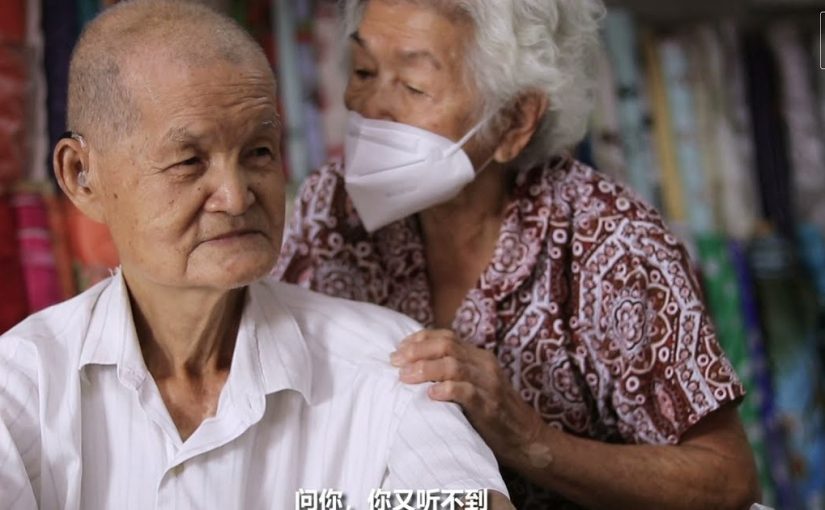
Teck Joo textile shop is managed by Mr Ho and his wife Madam Liew Ah Chan @ Liew Kok Moi, comprising half a shoplot filled with various textiles. The shop appearance is somewhat bleak, with the peeling paint on the signboard making it unclear. Arriving on foot, Mr Ho opens the metal shutters and lets down the wooden blinds to prevent direct sunlight exposure fading textile colors. Madam Liew, who suffers from reduced mobility thus requiring a lift from a friend, comes in later accompanied by her daughter. The old couple takes care of the shop together, chatting and joking happily, until five o’clock when they go home to rest. Such is their daily routine, enjoying old age in peace.

Mr Ho is born in Seremban, but moved to Tampin with his parents at five years old. During his youth, he worked in Singapore, where he met his wife, and decided to settle down in Tampin after getting married. Mr Ho co-founded a textile shop with a few friends, however they parted ways soon after, and he set up his own shop since 1958. Mr Ho’s father named the shop “Teck Joo”, implying ethical and fortune respectively. The early days of their start up were difficult, Mr Ho and wife had to tighten their belts to bring up eight children. During the great inflation in the 70’s, they toiled hard from dawn till night, thus managing to save up some money and lead a better life.

Teck Joo offers a range of common fabrics: plain cloth in red, white, and yellow for traditional rituals; batik for traditional Malay clothing such as baju kurung and sarung; premium suit fabrics are sought after by tailor shops. As large chain stores which offer more options at cheaper prices are established, and ready-made garments take over the clothing market, traditional textile shops in Tampin all closed down, except for Teck Joo.

Mr Ho and wife are happy-go-lucky, content to be running a small shop instead of building a business empire. Now that their children are self-sufficient, their means of making ends meet has turned into a pastime. All inventory payments are cleared, hence they are not too worried about the declining sales. The old couple even planned to contribute the fabrics to the needy after their retirement, as suggested by their son.

Over time, sweet and bitter moments in life are brewed into a cozy cup of tea. Apart from good health, Mr Ho and Madam Liew have nothing to ask for in their advanced age.

Text: Daniel Lim & Pua Hui Wen

有你 UNI Production
Producer : Daniel Lim
Cinematographer : Amelia Lim / Evon Pang / Michael Lerk
Drone : Daniel Lim
Video Editor : Michael Lerk
Copywriter : Pua Hui Wen
Music : 《The Home》 《Just A Little Hope》

COPYRIGHTS 2021 ECHINOIDEA SDN BHD

☕ Buy Us Coffee

Gunny Sack in Klang

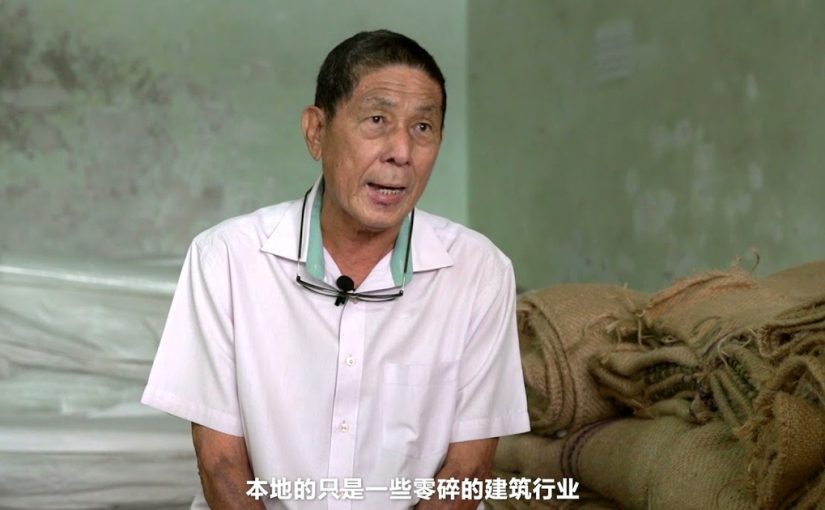
The pre-war shophouses along Jalan Raya Timur, a stone’s throw from Klang KTM Komuter Station, used to be a glorious business district on the south bank of Klang River. Several decades later, most businesses either moved out or closed down, among the few surviving is gunny sack dealer Yeo Hup Kee. The natural scent of jute permeates the immediate vicinity of the shop.

Yeo Hup Kee was founded during the golden era of Jalan Raya Timur in the 1940-50’s, during which the shophouses were fully occupied and businesses were flourishing, in stark contrast to recent years. Cracks and splinters are visible on the wooden plaque, the faded walls are laid bare by the wide-open collapsible gates, the high ceiling makes the interior appear spacious, the iron ventilation grille allows light and air to flow through. Glancing in through the unobstructed facade, orderly stacks of gunny sacks, jute rope, and jute cloth take up almost half the shop.

Gunny sacks are made from natural plant fibres, the intertwined strands give out a warm golden glow, and has a slightly coarse texture. They are reusable, recyclable, and biodegradable, which renders them eco-friendly. Gunny sacks absorb moisture, have good ventilation, and are durable, therefore widely used in agriculture and construction industries. Crops stored in gunny sacks stay fresh longer; wrapping plant roots in gunny sacks during transplanting helps conserve soil moisture, and the sacks will decompose into fertilizer; in construction, the base of column are wrapped with gunny sacks in the process of concrete curing.

Yeo Hup Kee deals with bulk purchase of used gunny sacks, which they clean, sort, and then export. The gunny sacks are mostly sourced from local cocoa processing facilities. The acquired sacks are shaken upside down to remove dust and debris. Holes need to be sewn up with jute rope. Sorting is carried out according to thickness, density, and size. The sacks are then tied up into bundles and stored away neatly.

The company’s late founder, Mr Yeo Cheng Swee, started from scratch upon emigrating to Malaya. At the beginning of his career as a second-hand goods dealer, he always travelled around on a bicycle. As the business grows, he acquired a shophouse on Jalan Raya Timur and registered a company named “Yeo Hup Kee”. Out of the 10 children brought up in the shophouse, Mr Yeo Kim Chong is the only one who succeeded his father in the business. Five decades have since passed, and with it he witnessed the ups and downs of gunny sack trading.

In the past, gunny sacks were highly sought after by grocery stores, rice wholesalers, rice millers, and the National Rice Corporation (BERNAS). Through experience, Mr Yeo Kim Chong could easily ascertain a gunny sack’s quality with just a touch. Since the 80’s, polypropylene (PP) woven bags and plastic bags gradually replaced the costlier and heftier gunny sacks as common packaging materials, currently only a handful of merchants remain in the trade. Due to the change in demands, Mr Yeo brought in PP woven bags and ton bags, adopting new strategies to build resilience.

With a flexible mindset, Mr Yeo developed his family enterprise towards a global scale by exporting gunny sacks to various countries, for instance India, Indonesia, and Thailand. Seeing that Mr Yeo has his hands full, his second daughter and son quitted their own jobs several years ago in order to help him manage the family business. Miss Yeo Yee Sim propels Yeo Hup Kee onto online platforms, broadening market reach. Cafes acquire used empty coffee bags as decoration, florists wrap bouquets in jute cloth for a rustic feel, while craftspersons weave jute ropes into baskets, rugs, and even chairs.

Due to space limitations, Mr Yeo set up a warehouse nearby for processing and storing large quantities of gunny sacks. Even so, he insisted on operating the old shophouse. Although it is tiring having to cover both sites, the shophouse is the legacy of his father, and full of fond childhood memories. Most importantly, old customers may be reassured that this store will always be around, at the same spot.

Gunny sacks pile on top of one another, Yeo Hup Kee transfers from one generation to the next, remaining at the dilapidated Jalan Raya Timur, waiting patiently for old and new friends to visit.

Text: Daniel Lim & Pua Hui Wen

有你 UNI Production
Producer : Daniel Lim
Cinematographer : Amelia Lim / Evon Pang / Michael Lerk
Drone : Daniel Lim
Video Editor : Evon Pang
Copywriter : Pua Hui Wen
Music : 《Beautiful & Inspiring Piano with Strings》

COPYRIGHTS 2021 ECHINOIDEA SDN BHD

☕ Buy Us Coffee