Bee Tai Bak in Lunas

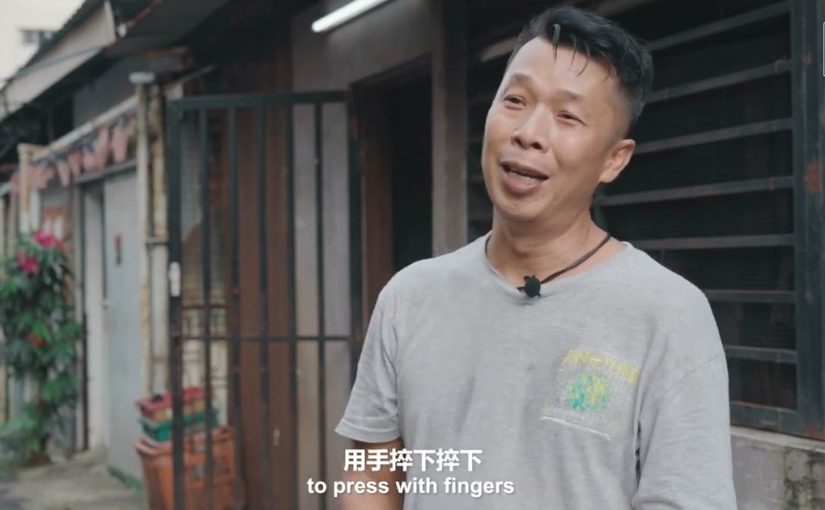
Everything is still and quiet in the wee hours, except for a slight drizzle and gushes of cold breeze gently swaying the coconut trees. Upon driving into the narrow path among the coconut trees in the heart of Lunas, a few wooden houses are scattered around, of which only one is brightly lit. The kitchen is filled with steam, a world apart from the cold outside. A large pot of boiling water sits on top of the wood stove. A stainless steel perforated metal mesh encased in a wooden frame is placed across the pot, a pair of seemingly heat-resistant hands work deftly; the right hand kneads the half-cooked, thick rice batter through the sieve, while the left hand retrieves the cooked, snow-white rice noodles – Bee Tai Bak.

Bee Tai Bak is a term transliterated from the Hokkien dialect. It is a type of noodle that is round and slender, tapering to a fine point at the end. In the Minnan region, Bee Tai Bak is typically served as a sweet cold dish, while in Singapore and Malaysia, it is more commonly found as a savory hot dish, prepared either dry or in soup. The chewy and bouncy Bee Tai Bak is often tossed in a fragrant sauce or submerged in a delicious broth, accompanied by fish balls, dark sauce minced pork, barbecued pork in slices as well as chunks, with chili sauce adding an extra kick.

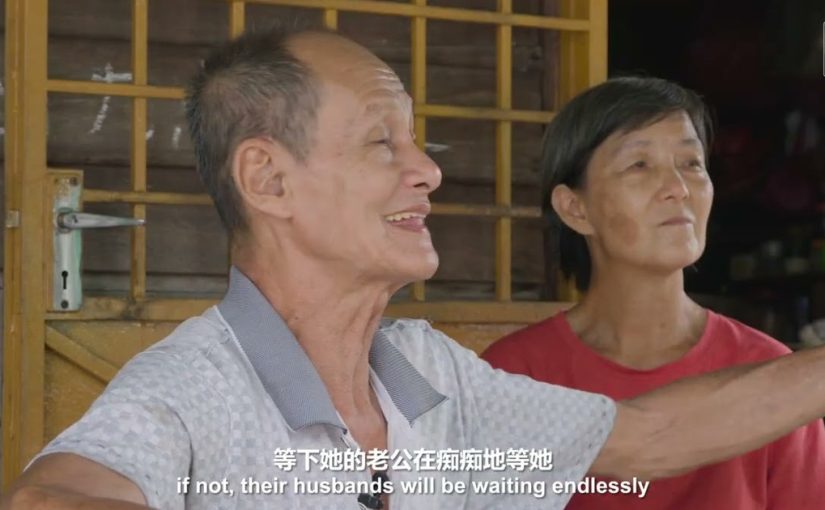
As the first rays of dawn illuminate the sky, customers begin to arrive, conscientiously parking their vehicles under the coconut trees to avoid obstructing others. Uncle Teh Guan Cheng and his wife Aunty Koh move from the kitchen inside the house to the stall in the back, busily serving bowl after bowl of Bee Tai Bak. Customers enjoy a hearty meal of steaming Rice Taimu in the soft morning light, plenishing energy to kick start the day. By 9:30 AM, the sunlight grows stronger, and those going to school or work have left, prompting Uncle Teh and his wife to close up.

Closing after merely three and a half hours of operation does not mean they can return to bed for extra sleep; instead, they seize the time to head out to purchase fresh groceries, preparing ingredients for the next day. Fresh pork needs to be marinated for several hours before being processed into dark sauce minced pork and barbecued pork. Barbecued pork is made from pork loin, which is the tenderest, best, and most expensive part of the pig. The chili sauce, which is free for customers to consume, is entirely handmade—from chopping the chili to simmering two large pots of aromatic sauce, each step is handled with delicate care.

This home-based Bee Tai Bak stall has stood in the same location for over 60 years without relocating. The previous owner, Mr Tan, ran it for 23 years, sourcing fish balls from Uncle Teh’s mother-in-law. Upon learning that Mr Tan planned to retire and sell the business, she suggested her son-in-law, who was a vegetable farmer, try his hand at it. After about six months of observation and research, Uncle Teh officially took over at the end of 1986, moving his family from Tasek Gelugor to operate this food stall in Lunas. Day in and day out, he and his wife work diligently, paying meticulous attention to each step from selecting and preparing ingredients to cutting and cooking, embodying the spirit of craftsmanship.

In this unassuming township, Uncle Teh and his wife embrace a leisurely lifestyle, living in simplicity while making each day busy and fulfilling. Before long, their young children are grown up and helping them out. The humble noodles from this village home under the coconut trees may one day succumb to the tide of development and eventually disappear, and now they seem closer to vanishing than ever.

有你 UNI Production
Producer : Daniel Lim
Cinematographer : Amelia Lim / Michael Lerk
Drone : Daniel Lim
Video Editor : Amelia Lim
Copywriter : Pua Hui Wen

COPYRIGHTS 2024 ECHINOIDEA SDN BHD

☕ Buy Us Coffee

Ho Yoke Kee : Traditional Cantonese Candies
Traditional Cantonese candies embody ancient wisdom. They preserve the shape and taste of the original fruit, albeit more exquisite. Before the invention of the refrigerator, slicing fruits and vegetables to boil with sugar and then air-dry could extend their shelf life without causing wastage and make them more delicious. The Cantonese use homophones to give candies auspicious meanings, making them a must-have festive snack during Chinese New Year. Candied coconuts mean three generations living together; candied ginger slices mean longevity; candied green peppers mean attracting wealth; candied carrots mean a house full of gold and jade; candied lotus seeds mean having children; and candied horseshoes mean getting things done successfully. Traditional Cantonese candies are also used in worship as offerings to welcome wealth and blessings, hence also known as fortune candies or five-color candies.

In Petaling Street, ​​Kuala Lumpur, which used to be a dominant Chinese settlement, only Ho Yoke Kee, a long-established street vendor that has been operating for decades, is still manually making and selling traditional Cantonese candies. On one side of the stall is a steamer filled with a hill-like pile of various rice dumplings, whereas on the other side is a wide selection of traditional Cantonese candies. From 6AM to 6PM, mother-in-law and daughter-in-law duo Yap Nyat Foong and Chong Yoke Yean take turns looking after the stall, while the third-generation successor Ho Chee Keong is in charge of preparations.

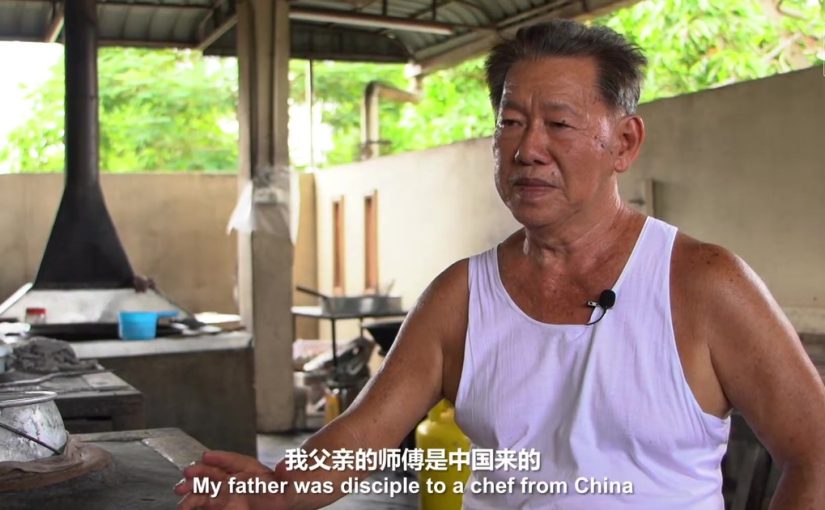
Ho Yoke Kee was originally named Ho Dui Kee. The founder, Ho Dui, came to Petaling Street from Dongguan, Guangdong, China in the first half of the 20th century and settled down in Petaling Street, selling lotus roots and other fruits and vegetables to make a living. Facing the unsold lotus roots, fruits and vegetables, he came up with the idea of making them into candies according to the traditional method of his hometown. Later, his son Ho Yoke and his daughter-in-law Yap Nyat Foong inherited this skill and worked together. When the stall had enough manpower, they expanded goods variety and started selling dessert soups and rice dumplings.

Although they have been street vendors in the same location for many years, they were unlicensed and had to evade the city council’s frequent crackdowns. They successfully obtained a license in the 1980s, and the stall was renamed Ho Yoke Kee, still in use today.They mainly sell rice dumplings and only a few types of candies. As Chinese New Year approaches, the variety of candies increased to more than a dozen types. During peak business period, the original stall sells rice dumplings, and they set up another stall selling in Cantonese candies for customers to buy by catties. Preparations must be done one to two months in advance in order to have sufficient supply.

Upon entering the kitchen, all the steps, from preparing the ingredients, such as peeling and splitting the coconut, grating and cutting the coconut meat, are all done by hand. The prepared ingredients need to be blanched to sterilize and remove impurities. Sugar is poured into the heated copper wok to boil into syrup to coat the ingredients. The most difficult variable to control during the cooking process is the heat. The viscosity of the syrup needs to be checked from time to time, as well as stirring constantly to avoid burning. Finally, the sugar-coated ingredients are placed in a bamboo tray and allowed to dry naturally until crystallization forms on the surface, which takes three days to complete.

Ho Chee Keong grew up living in Petaling Street, helping his parents at the stall, and was nicknamed “Rice Dumpling Keong” by the neighbours. After his father passed away, his mother struggled to take care of the family livelihood single-handedly. He made good use of the skills he had learned from childhood to help shoulder the burden of supporting the family, and gradually found an interest in his daily work. His grandfather Ho Dui passed away a few years before he was born, but the art of making Cantonese candies has been passed down from generation to generation. Only in recent years he made some adjustments to reduce sugar, in line with the modern concept of healthy eating.

The process of making rice dumplings and Cantonese-style candies is cumbersome, time-consuming and labor-intensive, but Mr Ho does not feel that life is hard, because the entire family work together and the days are filled with the fragrance of rice dumplings and the sweetness of candies.

有你 UNI Production
Producer : Daniel Lim
Cinematographer : Amelia Lim / Michael Lerk
Drone : Daniel Lim
Video Editor : Amelia Lim
Copywriter : Pua Hui Wen

COPYRIGHTS 2024 ECHINOIDEA SDN BHD

☕ Buy Us Coffee

Fuzhou Mooncakes in Ayer Tawar

The old-fashioned paper package is topped with a festive red brand flyer, tightly knotted with a thin string. Untie the string, remove the flyer, unwrap the paper package to reveal 12 small, round savoury mooncakes. Grab a piece and break apart layers of flaky crust, the filling is packed with umami, mildly oniony, with a hint of sweetness, yielding a springy texture. In Ayer Tawar, a small town in Perak where most of the population originated from FuZhou, savoury mooncakes are a Mid-Autumn Festival staple, perfect for gifting or own consumption, selling out fast when the season draws near.

The moon is exceptionally bright in mid-autumn, signifying a bountiful harvest in ancient agrarian societies, hence people pay homage to the moon, and mooncakes were originally an offering for the moon deity. Since the Yuan and Ming dynasties, the custom of admiring the beauty of the full moon while indulging in mooncakes, as well as gifting mooncakes, gained popularity and imbued mooncakes with cultural significance. To the FuZhounese pioneers of Ayer Tawar, traditional festivals sustain their earnest longings for their hometown. Back when resources were scarce, mooncakes were a precious delicacy, sharing among family members symbolizes unity and togetherness.

Most commonly seen are Cantonese-style mooncakes with soft glossy crust and sweet dense fillings. However, savoury mooncakes are SuZhou-style with flaky crust and savoury fillings, baked in a traditional grill oven. The savoury filling is made using pork containing both fat and lean portions, which is chopped by hand to ensure a supple texture instead of a sticky mince. Seasoned with salt, pepper, five spices, peanuts, sesame seeds, and green onions, it imparts a rich aroma after stir-frying. Lard is incorporated into the pastry dough to form a layered flaky crust, then manually insert the filling. The wrapped mooncakes are transferred onto a charcoal grill pan and covered with a charcoal-fired lid, baked on both sides for about 10 minutes until well done. 

Apart from savoury mooncakes, lard shortbread cookies are also a festive treat in Ayer Tawar. Made using steamed flour combined with castor sugar, eggs and lard to form a crumbly dough, pressed into wooden moulds, knocked to dislodge the pressed cookies, which are then neatly arranged onto trays to be oven-baked. Lard shortbread cookies can be eaten on its own, or made into a drink by adding hot water.

Fried glutinous rice sticks is a must-have during Mid-Autumn Festival family and friends gatherings. It is nicknamed “Mice Biscuits” due to its resemblance to newborn mice. Cute, crispy, and highly enjoyable, its production process is in fact cumbersome and time-consuming, with various factors affecting the success rate. The dough is made of glutinous rice flour, water, and yeast. After fermentation, the dough is rolled out and manually cut into inch-long strips, which are deep-fried until puffed up and golden in colour, then set aside and let cool. The fried glutinous rice sticks are first coated in a boiling maltose and sugar syrup, immediately followed by a layer of steamed flour. Excess flour is sifted off and it is ready.

Siew Hua Biscuits is among the few bakeries still producing traditional Chinese pastries in Ayer Tawar. Mid-Autumn Festival goodies such as savoury mooncakes, lard shortbread cookies, and fried glutinous rice sticks are only produced and sold in the month preceding the festival. Due to all items being freshly made with natural ingredients and no preservatives added, the shelf life is quite short, therefore orders need to be placed in advance, be it local pickup or interstate delivery. The second generation owner, 71-year-old Yak Sing King, said that he has retired and his son Yak Chou Liong is now in charge, yet he still toils away in the kitchen. The family members and a couple of workers start production from the wee hours till around 10P.M.

Gifting savoury mooncakes, lard shortbread cookies, and fried glutinous rice sticks together, the bulging paper package is full of delicious treats and sincere wishes from the giver.

Nowadays, these traditional foods do not conform to mainstream healthy eating habits, however they retain Fuzhou folk customs and etiquette, and reflect the cultural significance of traditional festivals.

有你 UNI Production
Producer : Daniel Lim
Cinematographer : Amelia Lim / Michael Lerk
Drone : Daniel Lim
Video Editor : Michael Lerk
Copywriter : Pua Hui Wen

COPYRIGHTS 2023 ECHINOIDEA SDN BHD

☕ Buy Us Coffee