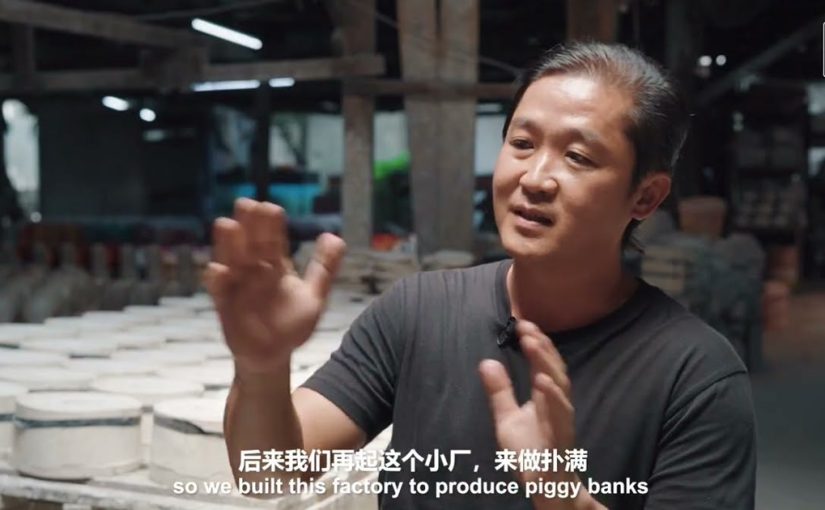
Clay piggy banks have been widely used since thousands of years ago. They have only one slit for inserting coins, and are broken open to remove them when full. The fact that it has survived to this day shows how important it is to cultivate the habit of saving. In recent years, cashless payments have become increasingly popular, and physical piggy banks are facing elimination, but in Ijok, there is a factory still producing traditional clay piggy banks. The colourful and attractive varieties include animals, gas cylinders, post boxes, and fruits. Each piggy bank produced carries the warmth from the hands of the second-generation owner, Ng Poh Huat, and his wife, Yin Shin Peng.
The Ng family roots can be traced to Teochew, China. Mr Ng’s grandfather moved to Malaya and made a living with his pottery skills. He first set up a factory in Kepong, but relocated to Kampung Subang to make way for development, yet history repeated itself, the factory thus relocated to its current site in Ijok about 30 years ago. Mr Ng’s father and his two siblings all work in the same industry, each leading a different production line: the eldest makes clay pots, the second makes piggy banks, the youngest makes dining ware.
47-year-old Mr Ng used to work elsewhere, but later chose to return home and take over the piggy bank factory from his father. The retired senior Mr Ng drops by occasionally to visit and help design piggy bank moulds. Since Madam Yin married into the family, she helped with the operations in the piggy bank factory, learning from scratch, as well as attending courses to upskill. When Mr Ng goes out to make deliveries, she is able to run the factory all by herself.
Clay piggy banks are made using the slip casting method, which is mixing kaolin clay with water into a mixture and pour into plaster moulds. Plaster moulds absorb water from the mixture, thus forming a layer of clay on the inner walls, taking the shape of the mould. Once the clay has solidified to a certain thickness, excess mixture is poured out, leaving only a small portion, then attach the cover securely and invert the mould, and wait till the next day to unmould.
With a small knife in hand, Madam Yin pries the plaster mould open, and takes out the piggy bank carefully. She cuts a slit about an inch in size, pats the bottom of the piggy bank to release air, and arranges it onto a wooden plank to air dry and solidify. The next step is refining the outline of the piggy bank, scraping off excess clay, and polish with water to smoothen the surface. After drying to 70-80% dryness, the piggy bank can be loaded into the kiln.
Nearly a thousand piggy banks of different shapes and sizes are stacked in the kiln, seemingly as easy as a building block game, yet in fact requiring a lot of brainwork and patience. The walls of the kiln are then sealed with bricks, the roof with zinc sheets, and a fire is kindled to dry the piggy banks over low heat for a day, until they completely dry. Then firewood is gradually added to increase the heat, until the temperature reaches about 1000 degrees Celsius, firing for about five hours before extinguishing, and let the piggy banks cool down, only unloading the kiln on the next day.
A layer of primer is applied to the piggy banks, to make the spray paint colours appear fuller and brighter. Mr Ng exercises precise control over the airbrush, spraying thinly in multiple layers, letting the surface dry before applying the next layer of a different colour to avoid pooling and runs. It takes half a day for the painted piggy banks to dry. Before packaging, Madam Yin adds a finishing touch to the eyes of animal piggy banks.
Clay piggy banks are diverse in style, many details still require great attention and human hands. Before being fired in the kiln, the piggy banks are still clumps of clay, grayish-white in colour, and can be reshaped even if it breaks; after being fired in the kiln, the piggy banks became pottery, yellowish in colour, once broken they must be discarded. The success rate is usually as high as 90%, but if it is unfortunately less than 50%, they had no choice but to suffer the losses.
Traditional piggy banks are pushed into decline due to changes in modern lifestyle and the shift to cashless payment methods. The piggy bank factory also produces goods used in folk religious practices, such as incense burners for worshipping Datuk Kong, and joss paper burners popular in northern Malaysia. Despite facing numerous challenges, Mr Ng and Madam Yin continue to run the traditional piggy bank factory, supporting their family.
有你 UNI Production
Producer : Daniel Lim
Cinematographer : Amelia Lim / Michael Lerk
Drone : Daniel Lim
Video Editor : Amelia Lim
Copywriter : Pua Hui Wen
COPYRIGHTS 2026 ECHINOIDEA SDN BHD
