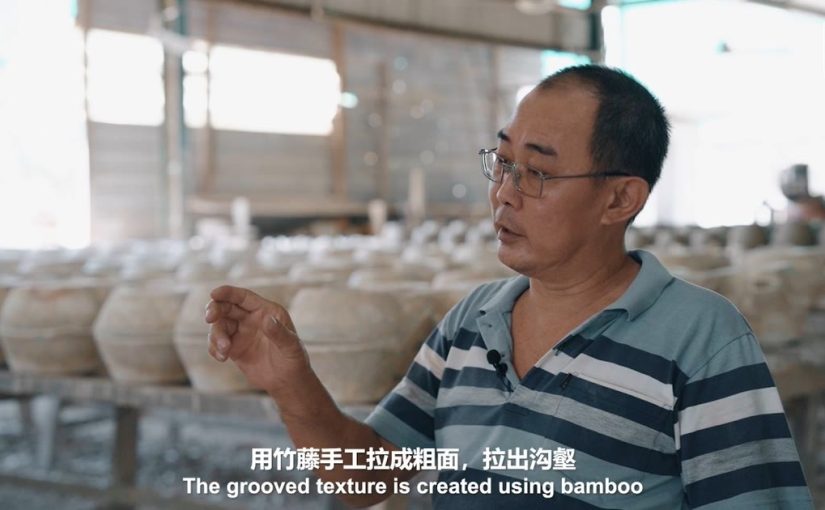
Ijok in northern Selangor is home to one of the few pottery factories in Malaysia that still uses a wood-fired dragon kiln to produce clay pots and medicine pots – Ng Pottery Enterprise. The TeoChew style of clay pot-making passed down three generations of the Ng family since their ancestors migrated south. From fully manual labour in the early days, to employing machinery and moulds nowadays, human hands remain essential for final touch-ups.
A dragon kiln stands towering at one end of the factory, about 20 metres long and 2.5 metres wide, with two kiln doors and several fire holes (for feeding firewood). Fully loaded, it can hold about 2000 pieces of clay pots and medicine pots. The kiln firing process takes three consecutive days, and requires round-the-clock monitoring, constantly adding firewood and closely observing the fire to maintain the temperature between 1200℃ and 1300℃ to ensure uninterrupted combustion. On day three, the fire is extinguished, and the kiln is left to cool down to room temperature before unloading.
Ng Pottery Enterprise is now run by the third generation, the elder brother Ng Lee Kwong and the younger brother Ng Ah Ming, who grew up playing with clay and inherited the family business. Their grandfather started out manufacturing clay pots, medicine pots, and rubber cups. Their father’s three siblings then branched out into different production lines. Their youngest uncle manufactures and supplies utensils to high-end hotels and restaurants; their second uncle produces everyday items such as piggy banks, kemenyan incense burners, and Indian diya lamps; whereas their father produces household cookware such as clay pots and medicine pots.
Thirty years ago, the Ng brothers took over this substantial clay pot factory from their father. It was the 1990s, and almost every household uses clay pots for cooking; business was booming. At that time, there were numerous clay pot factories throughout Malaysia. Later, with the rising popularity of electric cookers and induction cooktops, clay pots faced obsolescence, and many factories ceased operations. After all, clay pot manufacturing involves hard labour, intricate handiwork, time-consuming production process, and low profits. The two brothers are a good example of teamwork, weathering storms together, never giving up on the family business. Ng Lee Kwong is in charge of production, while Ng Ah Ming is in charge of sales and delivery, handling wholesale orders from Ipoh, Kuala Lumpur, Melaka, Johor, and even exports.
Over the decades since its establishment, the clay pot factory has relocated several times, from its original site in Kepong to Kampung Subang, until finally settled at the current location about 30 years ago. Each move meant a new dragon kiln had to be built. With the passing of the older generation who mastered the craft of kiln-building, the dragon kiln in Ijok may be the last. Year in, year out, the inner walls of the dragon kiln have developed a a glaze-like sheen, yet sharp edges are hidden within the beauty. Thermal shock may cause the kiln bricks to fall off or cave-in, the two brothers had no choice but to figure out how to perform repairs themselves. Since the original Japanese raw bricks have been discontinued, now they can only use building-grade red bricks instead.
Unwilling to see their ancestral craft lost in time, the Ng brothers persisted in running the clay pot factory despite facing numerous challenges. Each clay pot is not only a cookware bearing timeless culinary culture, but also embodies the Ng brothers’ hard work in continuing their family tradition.
【Locality Info】
Ijok is the name of both a town and a Chinese-majority village in Kuala Selangor, Selangor. It is strategically located at the intersection of Federal Route 54, connecting Kuala Lumpur and Batang Berjuntai.
In the early 20th century, Javanese immigrants settled in Ijok to cultivate the land, so most of the Malays in the town have Javanese ancestry. The town’s name is believed to derive from the Javanese word for green, “Ijo” or “Hijau,” symbolizing the lush green rice paddies of the past. Local legend also suggests that the area was named after palm trees called “Ijok” that once grew there.
During the Malayan Emergency in 1948, in response to the activities of the Malayan Communist Party, the British colonial government implemented the Briggs Plan, establishing Kampung Baru Ijok to relocate the Chinese community scattered across Ijok 8th Mile, 28th Mile, and Bukit Padang. Initially, villagers relied on vegetable and taro cultivation for sustenance, but switched to rubber planting in 1951 due to large-scale rubber plantation development by the British colonial government. As rubber profits declined, most villagers converted to oil palm plantations over 20 years ago. In recent years, with the support of the Selangor state government, many small and medium-sized factories have been established in Ijok, gradually transforming it into an industrial zone.
※
【Clay Pot Info】
Made from all-natural materials, clay pots have a porous nature which enhances food and tea aromas by allowing heat, moisture, and volatile oils to circulate, creating a slow-cooked, complex depth that seals in and rounds out delicate fragrance notes. Therefore, clay pots are widely popular across Malaysia, being the preferred cookware for Indians to cook curry, Malays to cook Tom Yam, and Chinese to cook Bak Kut Teh in.
※
【Medicine Pot Info】
Although modern people hardly use medicine pots to decoct herbal medicine, there is still a market demand for them — for melting gold. Goldsmiths need to melt gold to create various ornaments. Medicine pots can withstand the high temperatures of metal smelting, are chemically stable, and the side handle design allows for safe and precise pouring of the molten gold. Even if a medicine pot can only be used once, the cost is not too high.
有你 UNI Production
Producer : Daniel Lim
Cinematographer : Amelia Lim / Michael Lerk
Drone : Daniel Lim
Video Editor : Michael Lerk
Copywriter : Pua Hui Wen
COPYRIGHTS 2026 ECHINOIDEA SDN BHD
