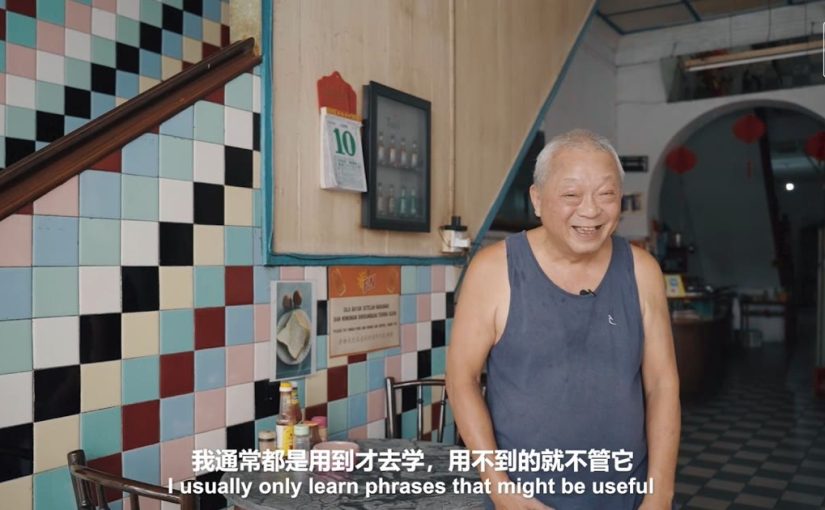
Upon stepping into Hang Chow Hotel in Georgetown, Penang, travel back in time to the 1960s, as if entering a scene in a Wong Kar-Wai film. The colourful wall tiles create visual depth and an artistic ambiance. The ground floor serves as a coffee shop, while the upper storeys consist lodgings with 12 rooms. It is among the handful of traditional hotels still operating in Penang, currently managed by the second-generation owner, Tan Eng Hock, and his wife.
At 9A.M., Uncle Tan opens the metal grilles, and goes on to wipe the marble tabletops and sturdy wooden chairs, while Mrs Tan is busy preparing ingredients in the kitchen. Lodgers who have already woken up come downstairs for breakfast, others are still snuggled up and dreaming away. The coffee shop is open until 4P.M., but the grilles remain open until midnight, providing lodgers ease of access.
Hang Chow Hotel occupies a pre-war building situated at the end of Chulia Street, with three storeys at the front and two at the back. The original purpose of its construction a century ago was lost in time, but in the 1930s it once housed the Adventist Mission Clinic by the Penang English Seventh-day Adventist Church (PESDAC). After the clinic moved out, Uncle Tan’s father bought the building together with a few friends, establishing the Central Hotel, running a coffee shop downstairs and lodgings upstairs. Around 1960, the partnership dissolved and Uncle Tan’s father became the sole proprietor, thus the hotel was renamed and renovated.
The name choice “Hang Chow” is not due to a connection with the city itself, but rather stems from Hangzhou’s millennia-long reputation as a paradise on earth, most people make the association and easily remember. The vibrant tiles also attract passers-by. A wooden staircase leads to the lodgings upstairs. The rooms are simply furnished with a bed, a table and chairs, and a washbasin. Common shower and toilet facilities are located in the courtyard, with a roof and skylight providing excellent natural light and ventilation.
Uncle Tan’s father hailed from HuiAn, Fujian, China. He came to Penang in the 1920s, building a new life from scratch with his lively mind. He started out as a rickshaw puller, then worked at the E&O Hotel, and later started his own hospitality business, and raised seven children. Uncle Tan, the second son, also entered the industry in 1970. After his father passed away in 1973, he assisted his mother in managing Hang Chow, until he officially took over in 1988.
The 1990s saw a tourism boom, Uncle Tan understood the importance of mastering international languages and successfully attracted European customers, establishing a foothold among the multitude of small hotels. There were long-term guests who stayed for weeks to months. Back then, a room cost RM6 per night; now, due to inflation, room rates start from RM60.
The coffee shop used to serve nothing else but coffee, tea, bread, and eggs. Since Uncle Tan took over, he rented out space to Indonesian Nasi Padang and western food vendors, but they all left after a short while. Therefore, he enlisted his wife to be the chef, serving simple meals. The whiteboard menu on the wall has been hanging in the shop since 1989, and is ever-expanding. Western dishes were added when foreign guests taught Mrs Tan to emulate their national dishes, after which she researched and developed an optimal version on her own.
Despite changing tourism trends and the decline of traditional hotels, Uncle Tan and wife still keep things running. Now in their seventies, they can no longer handle everything single-handedly, so they work within their abilities, hiring a housekeeper and a cleaner for the lodgings. For decades, they provide travellers a cosy resting spot and warm meals in Georgetown.
※
【Locality Info】
Chulia Street was one of the four main streets laid out by Captain Francis Light when Penang was first established in the late 18th century. It was originally named Malabar Street because of the large number of Indian merchants and Indian Muslims living there, and was later renamed after the Chola Empire of India.
The Chinese mainly came to Penang from the mid-19th century to after World War II. At that time, Chulia Street was a very busy commercial street, with many sheds for cattle that pulled carts carrying goods. Its Chinese name “牛干冬” (Gu Kan Dang) is a Hokkien transliteration of the Malay word “Kandang Lembu”.
Dr. Toh Teong Chuan, a Penang native who has written about Penang for many years, once described it as follows: “Gu Kan Dang” originally referred to only the latter part of Chulia Street from the entrance of Love Lane to the intersection with Penang Road. However, the area now generally referred to seems to have extended to the Beach Street section.
Chulia Street remains a bustling street, home to numerous traditional lodgings, hawker stalls, and distinctive restaurants and bars. It is regularly featured in the renowned global travel guide Lonely Planet as a core tourist hotspot in Georgetown, Penang.
有你 UNI Production
Producer : Daniel Lim
Cinematographer : Amelia Lim / Michael Lerk
Drone : Daniel Lim
Video Editor : Amelia Lim
Copywriter : Pua Hui Wen
COPYRIGHTS 2026 ECHINOIDEA SDN BHD
