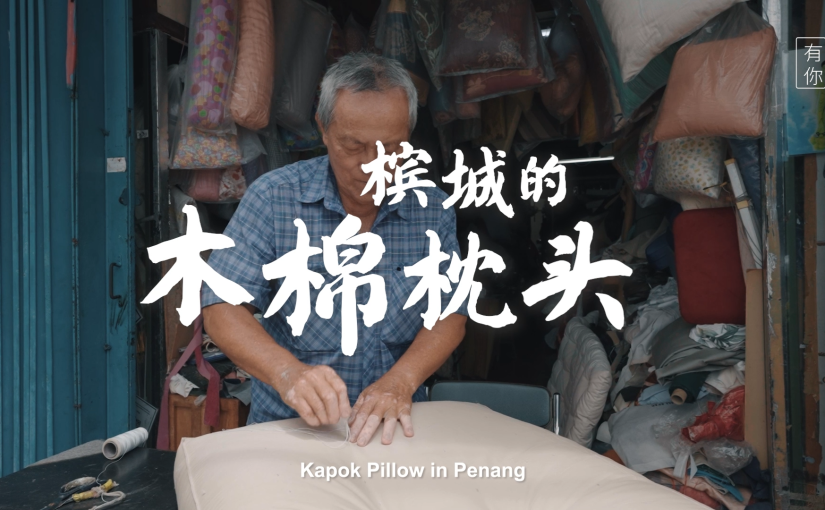
Pillows, bolsters, baby cots et cetera are stuffed with kapok, whose natural fibres provide soft and breathable comfort for a good night’s sleep. The craft of making kapok-filled bedding goods is passed down from generation to generation, spreading from Bishop Street to Church Street in Georgetown, Penang.
Two brothers, Teh Soon Seng and Teh Soon Teik, are the third generation to continue their family legacy, producing bedding goods stuffed with kapok. Over a century ago, their grandfather migrated to Penang from China, learned the craft of making bedding goods, thus establishing Hup Kee at Bishop Street, and raised a family. Their father followed in their grandfather’s footsteps, as well as their uncle, who set up Tee Decorations at the neighbouring Church Street. Among their eight siblings, Teh Soon Seng inherited his father’s shop and renamed it to Hup Kee Seng, while Teh Soon Teik set up Sim Hup Kee a few doors away from their uncle.
Branching out from the same family, the two brothers each manage their own store, the products they offer also differ slightly. Teh Soon Seng, the elder brother, specialises in making baby cots, and often takes in orders for custom-made products, such as meditation cushions. Teh Soon Teik, the younger brother, makes general items such as pillows, bolsters, and mattresses, as well as reupholstery.
In the past, there were four to five kapok bedding shops on Bishop Street. Hup Kee used to produce customised cushions for opium armchairs, as well as mattresses for military bases, hospitals, and hotels. During the free port era, Hup Kee even exported their products to the United Kingdom. After decades of ups and downs, witnessing the decline of the industry and the demise of their peers, Hup Kee is still standing, albeit on the verge of disappearing.
The willingness to uphold traditional craft is unable to withstand the crushing wheels of time. A shop manned by only a husband and wife duo possesses extremely constrained production capacity. They tried hiring employees, but many are reluctant to take on such a stifling and tedious job. Their children built their own careers, so as parents, they just have to let go. Without new apprentices, as they gradually age, they can only accept orders within their capabilities, barely making ends meet.
Instead of pursuing scale or quantity, they focus on meticulous sewing and quality. This craft still has market demand today, not only because the amount of fillings can be adjusted according to the customer’s preferences, but they also provide custom-made services for specific furniture, or use different fillings such as coconut fibres or feathers.
Nowadays, a diverse range of bedding goods are readily available, including polyester, foam, and latex, with various functional designs. Mass-produced polyester pillows are affordable, while others swear by premium ergonomic pillows, only the elderly still prefer simple kapok pillows.
Perhaps in a few years, there will no longer be kapok bedding goods shops in Georgetown, replaced by trendy cafés viral on social media. At that time, will anyone remember that there was once a family dedicated to making kapok bedding goods, making good use of their fingers and needles, just to let people have a good night’s sleep?
※
【Locality Info】
Bishop Street was named in honour of Father (later Bishop) Arnaud-Antoine Garnault, who had established his presbytery along the street and the first Catholic church in George Town at nearby Church Street. This original church later became the Church of the Assumption before it was demolished in 1857 and relocated to Farquhar Street.
In 19th-century Penang, Bishop Street was a bustling commercial centre, famous for carved wooden furniture and lacquerware artisans, hence known as “Chha Kang Kay” among the local Chinese community.
The Ghee Hin secret society, founded in 1790, set up its main headquarters at Church Street. At its peak, around 70% of Chinese residents in Penang were its members, hence Church Street was nicknamed “Ghee Hin Kay”.
有你 UNI Production
Producer : Daniel Lim
Cinematographer : Amelia Lim / Michael Lerk
Drone : Daniel Lim
Video Editor : Michael Lerk
Copywriter : Pua Hui Wen
COPYRIGHTS 2026 ECHINOIDEA SDN BHD
