It’s 7PM in the city of limestone peaks — Ipoh, the air is still damp after rain. A bunch of eager youths gather at the space in front of the row of shophouses in which Zhong Shen Trading nestled. After bringing out various props, they start practicing basic martial arts and lion dance moves under the guidance of Master Teh Wing Liang, then proceeding to train for plucking the Green.
Practicing martial arts is the foundation of lion dance, enhancing agility and endurance, which is crucial to the lion’s posture and aura. Master Teh leads his disciples through the routines of Hung Gar, comprising punches, footwork, as well as weapons. After practicing martial arts, their footsteps became steady and vigorous, making it easier to execute high-difficulty leaps as the lion head or handle the heavy lifting as the lion tail. Master Teh insists on solid training in traditional martial arts, ensuring lion dance keeps its true spirit and inner core instead of becoming just a superficial show. He also feels committed to nurture the next generation, hence establishing his own troupe — Zhong Shen Martial Arts and Lion Dance Academy.
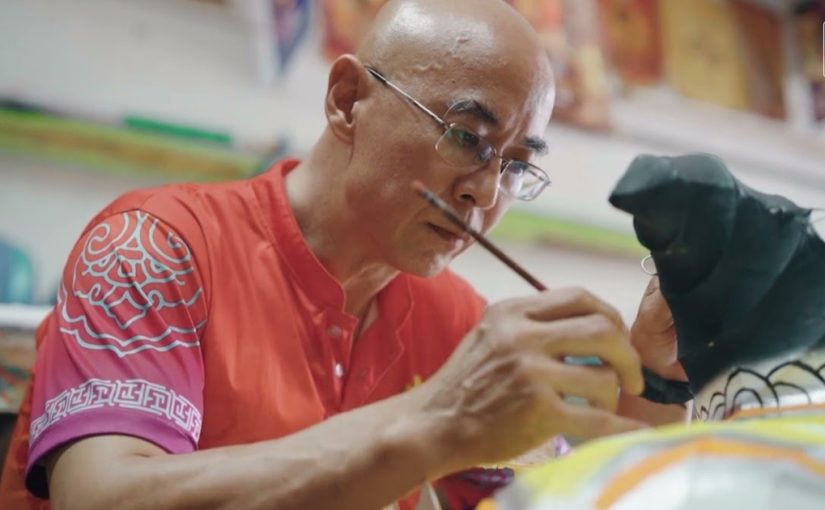
Teaching is just a side project to Master Teh, whose main job is crafting lion dance heads. Since a young age, he is immensely interested in arts, and has a knack for painting. During secondary school, he joined the lion and dragon dance troupe, and succeeded in crafting a dragon head from scratch at the age of 15. From that moment on, an ambition to pursue a lifelong career in crafting was sparked. After graduation, his passion did not fade. During the day, he works various odd jobs, and in the evening, besides practicing at the martial arts association, he also restores dilapidated lion heads for schools and other troupes. Meanwhile, having been introduced by his master from the martial arts association, he began crafting lion heads for troupes in Singapore. He managed to save up a sum of money and established Zhong Shen Trading on April 11, 1996 despite uncertain prospects and persevered all the way to this day.
Be it lion head or dragon head, the four main steps are: framing, pasting, painting, and decorating. Construct the frame with bamboo strips, paste fabric and paper to form the base, hand-paint colours and patterns, and then install the components and decorative accessories. When constructing the frame, the challenge lies in mentally visualising the proportions of each part according to the required dimensions. Achieving properly balanced structural angles when binding bamboo strips together is equally critical. When pasting, ensure the surface is smooth, taut, and wrinkle-free. Paint with even strokes to ensure uniform colour and avoid jagged edges. Decorating is relatively easy, just need to make installations are securely attached.
Master Teh was just 13 when he first stepped into the world of martial arts, lion dance, and dragon dance. 38 years of passion and 30 years of building his own career have transformed that young boy into the craftsman he is today. Living a simple but full life, he works daily at the shop, carving out time for his own training, teaches several weekly classes, and occasionally leads his troupe to performances or competitions. As modern lifestyles and entertainment habits change, people with a genuine passion for dragon and lion dancing are becoming fewer and further between. Nevertheless, there are still several troupes active in Ipoh, operating under different models; yet Master Teh remains steadfast in his commitment to training traditional martial arts fundamentals.
As one of the few full-time dragon and lion craftsmen in Northern Malaysia, Master Teh’s creations not only supply the local market but are also exported to Singapore and Taiwan. He also excelled in painting deity portraits, drawing frequent commissions from various temples and Taoist priests.
A martial artist by training, a lion dancer by heart. Dedicated to the craft and teaching, Master Teh Wing Liang keeps cultural heritage alive with unyielding passion.
※
【Lion Dance Info】
During the Eastern Han Dynasty, various kingdoms from the Western Regions presented lions to the Central Plains as a form of tribute. People eventually began mimicking the appearance and movements of these lions for performances, which became the earliest prototype of the lion dance.
A lion dance performance requires a high level of tacit teamwork and coordination among the lion head, the lion tail, the drummers, and the coach.
The Lion Head is responsible for controlling the lion’s expressions and executing most of the lifting, jumping, and high-climbing movements. This role demands exceptional strength and endurance.
The Lion Tail is responsible for matching the footwork of the lion head, controlling the shape and balance of the lion’s body, and supporting the lion head during high-difficulty stunts.
The Musicians are responsible for playing the drum, gongs, and cymbals. The music and the lion’s movements must be perfectly synchronized.
The styles of lion dancing are divided into Northern and Southern variations, each featuring vastly different appearances and movements.
Northern Lion
- Also known as “Sacred Lion”, popular in regions north of the YangTze river in China.
- Furry all over, comprising male and female, gentle and fierce, adult and cubs.
- Incorporates acrobatics, featuring skillful maneuvers such as stepping on balls and vaulting over springboards.
Southern Lion
- Also known as “Auspicious Lion”, popular in the region of GuangDong, emphasising martial arts fundamentals.
- Fut San Lions have rounded heads, broad foreheads, a wide mouth, overall full and robust with aggressive movements.
- Hok San Lions have relatively flat heads, a protruding mouth, overall light and agile with gentle movements.
- Only males, featuring either scholarly or military traits
With the 19th-century wave of immigration into Malaysia came the Southern Lion, which originated in the GuangDong region, primarily represented by the Fut San and Hok San variants. Lion dance was intertwined with martial arts associations, serving as a complementary training methods. Practitioners would first build a solid foundation in basic martial arts before integrating routines into the lion dance movements.
In the past, when lion dance troupes from rival martial arts associations crossed paths, they would fight to prove their superiority. As times changed, lion dance became part of schools and community groups, evolving into a healthy form of physical fitness for youths.
※
【Plucking the Green】
During festivals or shop grand openings, lion dance troupes are invited to perform to ward off evil spirits and bring good fortune and prosperity. The most exciting part of the performance is “plucking the Green”, where the lion navigates obstacles to capture food. This food typically consists of cabbage (symbolizing prosperity), tangerines (symbolizing good fortune), or simply a red envelope containing money.
※
【Lion Head Sizes】
The lion heads are generally classified into Size 1 (Large), Size 2 (Medium), and Size 3 (Small).Today, Size 2 and Size 2.5 are the most popular and widely used, while teenagers usually dance with Size 3. To accommodate young children or for use as decorative pieces, even smaller sizes have been introduced, including Sizes 4, 5, and 6.
有你 UNI Production
Producer : Daniel Lim
Cinematographer : Amelia Lim / Michael Lerk
Drone : Daniel Lim
Video Editor : Amelia Lim
Copywriter : Pua Hui Wen
COPYRIGHTS 2026 ECHINOIDEA SDN BHD
