Xin Yan Hwa Hokkien Opera Troupe

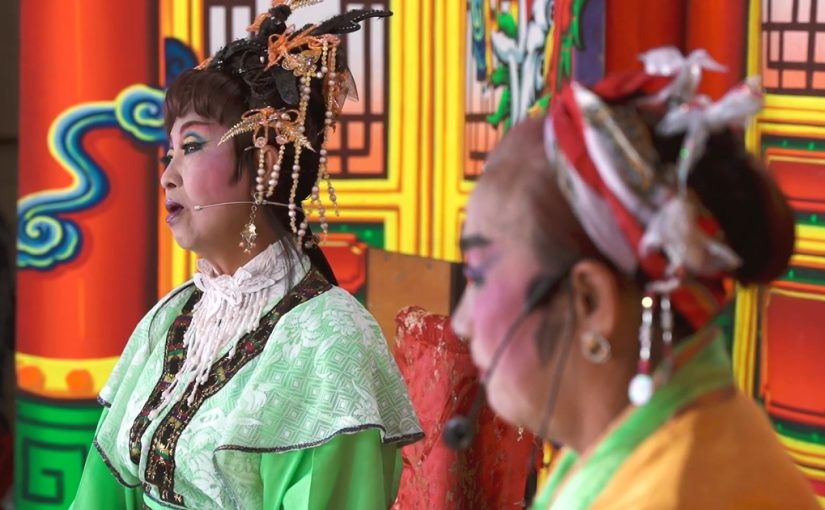
Go A Hee, also known as ‘Min opera’ or ‘Hokkien opera’ within Southeast Asia. Long ago, due to their topography proximity to the sea, the distinctive feature of Southern Min people migrating overseas was shaped. Towards the end of the 19th century, the peak season of Southern Min people migrating overseas, large crowds of them migrated to Southeast Asia. Concurrent with the shaping of local Min overseas Chinese communities one after the other, conditions for the spread of Hokkien opera are furnished, thus Southeast Asia became an important region for overseas spreading of Hokkien opera.

Due to the language and tunes of Hokkien opera bearing regional characteristics and life-like, easy to understand, as well as having three-dimensional backgrounds and flamboyant costumes, in the 1920’s it was enthusiastically sought after by the Southern Min community, becoming a spiritual bond between Southern Min people who migrated overseas and their hometown. It also serves as a thanks offering ceremony in temple worshipping.

In the multiracial grounds of Malaysia, Hokkien opera experienced development transplant and climax, from the heyday in the 30’s prompting the forming of Hokkien opera troupes in several regions, at the same time attending international exchanges abroad; to gradually declining in the 60’s, only appearing as entertainment on religious ceremonies and festive celebrations. Hokkien opera faces various severe challenges: lessening of the older generation audience, lack of interest from the younger generations, no inheritance of the performance art, lack of support from the government, competition from overseas troupes etc.

There are now less than 20 Hokkien opera troupes who are still actively performing in Malaysia, however it comes as a comfort that there are still a group of passionate old opera artists who persist.
For instance this troupe from Batu Pahat, Sin Yan Hwa Hokkien Opera Troupe, 74-year-old head Tee Siew Foong (transliteration) learnt opera skills since a tender age, performing in several Singaporean troupes in her youth, and established Sin Yan Hwa Hokkien Opera Troupe using her two daughters’ names over 30 years ago. Madam Tee frankly states that when her stamina used to be good, she travelled long-term all around Malaysia in honour of invitations to perform, and she is grateful and fortunate to continue to maintain the opera troupe, pursuing a career in her passion.

Worth mentioning is another folk opera performance of Sin Yan Hwa Hokkien Opera Troupe: Bo Te Hee, also known as Puppetry. During grand events such as funerals, weddings, carnivals, and festive celebrations, Puppetry must be performed as a token of respect.

Text: Daniel Lim & Pua Hui Wen

有你 UNI Production
Producer : Mok Yii Chek
Coordinator : Daniel Lim
Cinematographer : Amelia Lim / Evon Pang
Video Editor : Amelia Lim
Production Assistant : Michael Lerk
Music : April Rain from Felt Music

COPYRIGHTS 2019 ECHINOIDEA SDN BHD

☕ Buy us coffee

Facial Threading

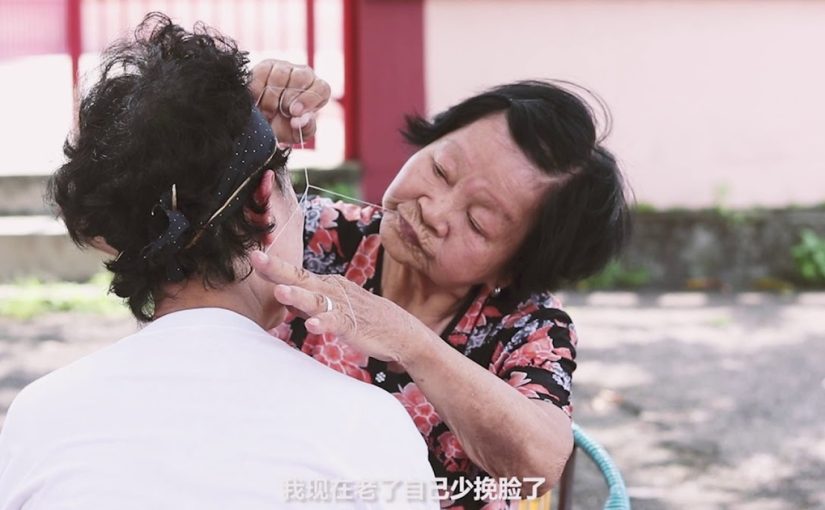
A riddle goes like this: “Four eyes staring at each other, four legs clashing with each other. One bites hard, another’s face hurts”, describing this traditional beautifying skill —— facial threading, also known as shaving fine hairs. Facial threading could be said as a wisdom and technique passed on from ancient times, using one simple tool to get rid of fine facial hair, dead skin and even acne. At the same time, it enhances blood circulation of the face, as well as keeping the skin smooth and shiny.

A scorching sun shines bright in the sky, beneath luscious tree shades, with two low stools, a spool of cotton thread, polishing powder, hairpin and a comb, Grandma Teo Yoke Kim bites on one end of the thread, her right hand holding the other end, the cotton thread curled around her left hand like scissors, forming three points coordinating with each other to exert force. Grandma Teo uses the intertwined knot to move back and forth on the skin and pores, quickly and effectively clean fine hairs and dead skin off the face. This unique technique attracts full attention of bystanders, and is much admired.

Since a tender age, Grandma Teo observe the way her elders in the village do facial threading, thus acquiring the skill. As the elders pass away one by one, Grandma Teo also gradually age. Now that she is 86, she seldom does facial threading for others, the younger generation has no way to pick up the technique. The people who mastered this traditional skill are getting fewer in numbers, which is regrettable.

Text: Daniel Lim & Pua Hui Wen

有你 UNI Production
Producer : Mok Yii Chek
Coordinator : Daniel Lim
Cinematographer : Amelia Lim / Evon Pang
Video Editor : Amelia Lim
Music : Mellowlands from Felt Music

COPYRIGHTS 2018 ECHINOIDEA SDN BHD

☕ Buy us coffee

Festival at Then Hou Temple in Hainan Village, Port Dickson

Hainan Village in Port Dickson has been in existence for more than a century. With the outflow of youth, only 35 households remain residing.

The Then Hou Temple built in the village is a hundred years old, and organises an annual festival occasion during 23rd March of the lunar calendar to celebrate The Empress of Heaven (Mazu)’s birthday. The village population who reside in dispersed outstation areas would return to their hometown, and work collectively to cook traditional Hainanese delicacies such as mutton soup for the consumption of villagers and guests alike, joining in celebration and making merry together. Meanwhile, there is hope that the Hainanese culture could be inherited from one generation to another, the legacy of traditional Hainanese dishes and customs continues.

Text: Daniel Lim & Pua Hui Wen

有你 UNI Production
Producer : Mok Yii Chek
Cinematographer : Amelia Lim / Evon Pang
Video Editor : Evon Pang
Music : Troutdale from Felt Music

COPYRIGHTS 2018 ECHINOIDEA SDN BHD

☕ Buy us coffee