Sin Keng Wah Mattress Shop

Cities developed around waterways, people settled along canals. Sungai Segget, the “Mother River” of Johor Bahru, has been an important marine transportation connection since the city’s cultivation in 1855, the basis of the city’s economic growth. In the earlier days, Chinese forefathers who migrated to Johor Bahru settled along the shores of the 4-kilometre long Sungai Segget which naturally split the city into East and West shores. Spurred by famous entrepreneur Mr Wong Ah Fook, the East shore is full of commercial buildings where consumer and entertainment services prevailed, while the West shore is pioneered by the most powerful Kangchu in Peninsular Malaysia Mr Tan Hiok Nee, its longest avenue Jalan Trus is where the local Chinese community mainly convene.

Johor Bahru underwent drastic changes over the past century. Under the Sungai Segget Rejuvenation Project carried out by the city council, merely 300 metres of the river course remain. An ancient temple and most double-storey shophouses were retained on Jalan Trus, however as Chinese guild halls and enterprises gradually moved out, the area transformed into “Little India” with Indian clothing shops, gold shops, and a few old stores which stood for decades, such as Sin Keng Wah Mattress Shop.

Established in 1964, Sin Keng Wah is known for handmade pure cotton pillows, bolsters, baby cots, and other bedding items, as well as customization services. Formerly, the shop was operated by a Singaporean, whom the father of the current proprietor Mr Yeow used to work for. During the economic malaise leading to Singapore’s separation from Malaysia, he decided to sell out, thus Mr Yeow’s father and elder brother bought over and renamed it to Keng Wah. Now the second generation owner, Mr Yeow Sien Soon prefixed a “New” to the shop name since his succession. All the while, they rented the same shoplot from an old landlord who knows them thoroughly, maintaining a fond relationship as he lives upstairs. The ancient plaque bearing “Eng Seng” which hung on the upper left corner of the shop entrance was the signboard of a grocery store the landlord used to operate.

Founded over half a century, Sin Keng Wah earned a good reputation for quality bedding that are fluffy, well ventilated, has thermoregulation effects, as well as absorbs moisture. Mr Yeow uses natural kapok cotton imported from Thailand, without mixing any impurities. Lately there has been a raised awareness of health benefits using pure cotton bedding, especially people with backaches or night sweats, and even newborn babies. Thus they accumulated regular customers including the Johor royal sultanate. By chance, Mr Yeow accepted plenty of customized orders from the royal family, and often visits the palace to measure the respective furnitures, as well as seeking audience with the Johor sultan. He said in jest that despite facing pressure from the stern guards and His Majesty’s grandeur, he is touched by the sultan’s friendly attitude, greeting him with “Ah Pek” in a sonorous voice.

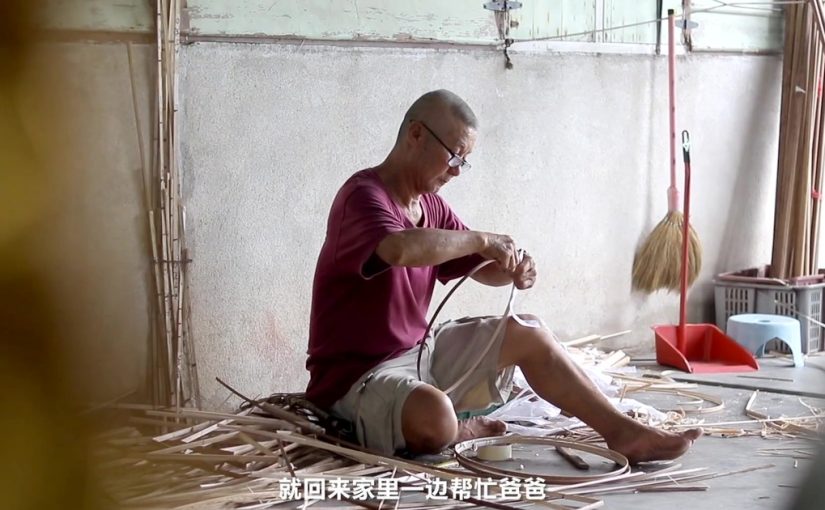
In this era of mechanization, traditional handmade items are getting increasingly rare. Mr Yeow persisted to manually sew bedding, ensuring that kapok fibres are distributed evenly without bulky bits, so that users could fall asleep comfortably. Moreover, the ability to customize different shapes and angles could not be replaced by machinery. The skills involved in manufacturing bedding could not be mastered within a short timeframe. From picking cotton, pinning threads into place, cutting fabric, measuring inlet, to using a sewing machine, the procedures are very challenging. The flexibility of the fabric needs to be taken into account in order to ensure the finished product meets the correct size. Besides, delicate kapok fluff may cause respiratory irritation. To avoid absorbing moisture during storage, kapok is kept in a stifling storeroom. Poor work conditions increased difficulty to hire employees.

63-year-old Mr Yeow inherited the family business for 46 years, recollecting how other two fellow tradesmen in Johor Bahru closed down due to no successors, he is glad that his eldest son Boon Teck takes over this traditional mattress shop. From being an uninterested layman to getting guidance from his strict father, and taking the initiative to explore this trade, Boon Teck is able to work independently after about ten years. Since graduating in 2000, he gave up his ambition of being a painter to stay and help his father in the family business. Moving on, he recognises the cultural value of this trade and sparked interest in designing new products, as well as utilising social media to expand customer base.

The Yeow family passes on the skills of crafting bedding from father to son, the dented sides of the century-old workbench in Sin Keng Wah is where three generations of tradesmen sharpened needles, witnessing that mastery is achieved from experience. The bedding is not only stuffed with pure kapok, but also cultural heritage and warm feelings.

Text: Daniel Lim & Pua Hui Wen

有你 UNI Production
Producer : Mok Yii Chek
Coordinator : Daniel Lim
Cinematographer : Amelia Lim / Evon Pang
Video Editor : Michael Lerk
Production Assistant : Michael Lerk
Music : Tido Kang from YouTube

COPYRIGHTS 2020 ECHINOIDEA SDN BHD


☕ Buy Us Coffee

New Kwong Weng Watch Shop

Opposite the mini stadium in Renggam, Johor, there is a row of antique single-storey wooden shops, New Kwong Weng watch shop inconspicuously situated among them for almost nine decades. As its light blue metal shutters slowly open, various grandfather clocks, mantel clocks, and wall clocks come into sight, the regular rhythm of ticking clocks bringing peace to the mind. This historic watch shop is the only place for traditional watch and clock repairs in Renggam, the 2nd generation successor master Chong Lin Kiam is hailed as “Clock and watch doctor” who rescues timepieces. Countless clocks and watches came back to life under his able hands, and there often are clients from Kuala Lumpur or even Singapore who send their collection of luxury watches for repair.

About 40 years ago, master Chong succeeded the shop established by his father in 1932, adding a “New” to the original shop name “Kwong Weng”. The senior Mr Chong used to be a farmer in China who lost his hard-earned savings during a locust disaster in the 1920’s, therefore he moved overseas to make a living in Johor Bahru. He learned the trade of repairing clocks and watches from his fellow hometowner who conducted him to Malaya, and moved to the rapidly developing Renggam by coincidence, setting up his own shop on the busy main street, in a row of the earliest buildings in Renggam town. The narrow space behind the shop which used to be a storeroom was turned into lodgings after being rented by the senior Mr Chong, who brought up several children with this mere trade.

In the earlier days, numerous estate managers and foreign business owners gathered at Renggam, having great demand for clocks and watches repair services, back then there were 2-3 watch shops in town including Kwong Weng. Despite the Japanese occupation of Malaya, the business of watch shops was not affected. The Japanese soldiers were honest and paid up promptly when they sent their watches for repair, only threatening the watch repairers with their weapons upon receiving poor service. Having cautiously operating for over two decades, the senior Mr Chong finally received a trade license from the British colonial government in 1955, as well as another zinc license plate from the Malaysia government in 1975, both well-maintained to date, as master Chong hung them in the shop in honour of his father’s hard work and toil in entrepreneuring.

Master Chong has been helping his father in the shop since teenage, gradually fathoming the mechanical principles of clocks and watches, subsequently inspiring an enthusiasm in repairing them. According to master Chong, beginners should start learning to repair alarm clocks which have larger parts, only switching to repairing watches after grasping the basics and becoming adept. Various tools available in the shop are heirlooms from his father, whereas the array of old spare parts were procured from outstation associates, as some of the watch shops conformed to the changing times to sell electronic watches therefore selling off obsolete mechanical parts. Even though electronic watches are trending, the unique charm of mechanical watches expand their value for collection, watch repairers who are savvy in mechanical principles and have exquisite craftsmanship are particularly sought after. Master Chong’s son also became a watch repairer under his influence, and is now working in the repair department of a luxury watch shop at Kuala Lumpur.

The process of disassembling, cleaning, repairing, and reassembling a luxury watch puts patience to test as well as time-consuming. Fortunately master Chong who has over 50 years of experience in watch repairing still has sharp eyesight and agile hands even though he is nearly 70 years old. Sitting in front of his workbench wearing a loupe, he steadily grips the tweezers, carefully arranging the petite parts on a small white tray, closely inspecting every single detail, striving to find out the exact problem to restore the watch’s functionality and accuracy. Among the luxury watches master Chong often repair are Rolex, Panerai, Omega, Longines etc. Their structures are complex and delicate, the original mechanisms might be accidentally fragmented. Therefore he often purchased European watch magazines to study their technical innovations as well as polish his own skills.

Helmed by two generations, its craftsmanship passing down to the third, New Kwong Weng watch shop stood witness to the changes in watchmaking technology over the years. Quality is upheld by dedication in reviving the heartbeat of mechanical clocks and watches. Watch repair skill is a timeless legacy, allowing mechanical devices to continue measuring time step by step.

Text: Daniel Lim & Pua Hui Wen

有你 UNI Production
Producer : Mok Yii Chek
Coordinator : Daniel Lim
Cinematographer : Amelia Lim / Evon Pang
Drone : Daniel Lim
Video Editor : Amelia Lim
Production Assistant : Michael Lerk
Music : Just Stay

COPYRIGHTS 2020 ECHINOIDEA SDN BHD

☕ Buy Us Coffee

Attap Roof Weaving

Originating from Kuala Kubu Bharu dam, the 110-kilometres-long and winding Selangor River flows through Kuala Selangor into the sea. Under the blazing sun, on the riverpath along Kampung Kuantan in Kuala Selangor, Uncle Jamaluddin bin Zakaria could be seen paddling a small sampan against the tides, slowly approaching the stifling mangrove forests, starting his day’s gathering job.

Two types of palm tree leaves are usually gathered by Uncle Jamal: Daun Nipah and Daun Sagu/Rumbia. Nipah leaves, also known as Attap leaves, are gathered from Nipah trees which grow in humid swamps, measuring 2-3 inches in width and a few feet in length. Also from the palm family, Sagu trees grow on the shores, with tall tree trunks and narrower but thicker leaves. These two types of leaves are local roofing materials gathered by Malay forefathers. Having good air permeability as well as dispelling heat, attap roofs are suitable for the equatorial climate, commonly used within Malaysian communities.

Upon arriving at his destination, Uncle Jamal ties his boat onto the wooden stump, taking out his parang knife for mandatory sharpening. Having been induced by his parents to this traditional trade since a tender age, Uncle Jamal has decades of experience in gathering, obvious from his adept actions in cutting down sheaths of leaves. Firstly, he stands two pieces of stem vertically to mark the collection point (Celung in Malay). Then, he separates the leaves piece by piece from both sides of the sheath. As the leaves pile up, he peels a fine strand of fibre from the sheath to make a natural rope, to tie up the heap. These skills are mastered and inherited by Uncle Jamal’s family for several generations, demonstrating ancient wisdom in utilizing natural resources.

Uncle Jamal then carries the pile of leaves to unload onto his sampan, and makes his way back with the receding river tides. On the other hand, 65-year-old Aunty Zainab binti Daud sits underneath the tree shades in front of her house, surrounded by Attap leaves and ropes, her nimble finger movements showcasing decades of weaving skills. Aunty Nab arranges and folds Attap leaves neatly onto a thin and long bamboo stick with her left hand, while threading a rope through the two layers of leaves with her right hand. Moments later, a piece of shelterable Attap roof is born under her deft hands.

Since childhood, Aunty Nab followed in her parents’ footsteps, being in charge of both gathering and weaving Attap leaves during her youth, hence she is proficient in the whole process of this traditional folk skill. In the olden days, forefathers ripped Bemban trees sheaths into fine strands to be used as ropes in weaving Attap roofs. As more forest grounds were developed, at present Bemban trees are almost extinct, being replaced by bamboo ropes or plastic ropes. Now that Aunty Nab is getting old in retirement, she still weaves Attap roofs in her free time as a side income. The majority of her life is interwoven with Attap leaves into a brilliant tapestry.

Similar to a giant-sized comb, the woven Attap roof requires one to two weeks of sun-drying. Neatly layered onto the roof beam, a canopy combining both natural and artistic elements is built. Although Attap roofs are durable and appealing, they require regular maintenance, as well as major replacement every few years. Therefore, sturdy and practical materials such as zinc and tiles gradually replaced Attap roofs. However, the lack of air permeability led to a stuffy interior. In this light, Attap roofs still have their unique attractivity, being constantly in demand. Recently trending homestays and themed restaurants employ Attap roof designs to create a sense of rural nostalgia, enabling tourists and customers to experience rustic culture, as well as embrace Mother Nature. Attap roofs are once again in the limelight.

Attap and Sago leaves used to be commonly found in the forests, alas they are increasingly hard to find in recent years, Uncle Jamal needs to travel far away to collect sufficient leaves to cater for orders placed. The development of forest grounds directly impacted the natural growth of plants, and he is forced to enter even more secluded areas to gather. Back to the shores of Kampung Kuantan, there still are 3 to 4 Aunties skilled in weaving Attap roofs who are all over 60 years old, yet persist in weaving 50 to 60 pieces of Attap roofs daily. Perhaps some years later, this centuries-old skill will fade away.

Text: Daniel Lim & Pua Hui Wen

有你 UNI Production
Producer : Mok Yii Chek
Coordinator : Daniel Lim
Cinematographer : Amelia Lim / Evon Pang
Drone : Daniel Lim
Video Editor : Amelia Lim
Production Assistant : Michael Lerk
Music : Dreamland

COPYRIGHTS 2020 ECHINOIDEA SDN BHD

☕ Buy Us Coffee