Dexon Button Shop

Dexon Button Shop is located on the ground floor of an old shophouse in Jalan Petaling, Kuala Lumpur. Numerous stalls in front of the five-foot way formed a barrier in which the shop is tucked away. Going through the narrow passageway leading to Dexon Button Shop, the sunlight rays which fall on the front of the shop radiates a special charm. Another captivating sight is the neat and compact wooden cabinets and the dazzling array of buttons on display inside the shop. A myriad of metallic buttons, shell buttons, wooden buttons, plastic and increasingly rare fabric buttons are procured both locally and internationally.

Apart from offering a multitude of buttons, Dexon is also a haberdashery, selling zippers, needles and thread, scissors etc. At the same time, Dexon is one of the few shops in Petaling Street which is family-run by Chinese owners to date, a 40-year-old establishment still in business today. The signboard hanging above the shop entrance became faded over the years, contrasting with the semi-circular column aside which retains bright scarlet letters. The two antique machines——a manual riveting machine and a fabric button machine, are not commonly found among haberdasheries.

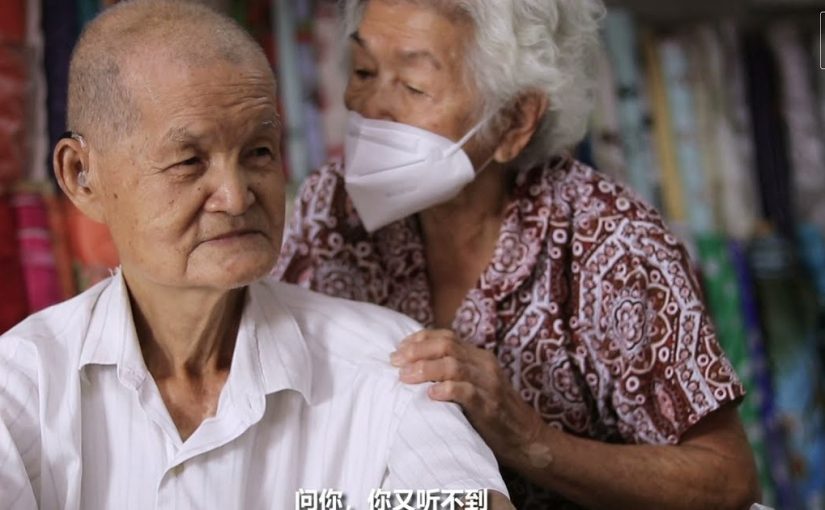
The founder of Dexon Button Shop, Mr Chai Chang Nam, hails from Kuala Kangsar, Perak. During his youth, he worked at a tailor shop in Kuala Lumpur. When the shop ceased operations, he started his own haberdashery business at a corner on Jalan Tun H.S. Lee. After a fire incident, Mr Chai shifted to a half shop at No.37 Petaling Street. Later on, the property owner sold the shoplot to a hotel operator, he had no choice but to relocate. Fortunately another shop is available a stone’s throw away, thus he occupied the current premises at No.45 Petaling Street in 1992. The grand reopening was a major event, congratulatory flower stands from his peers almost filled the entire five-foot way. Mr Chai’s second daughter Villy vividly recalls the shop was as if a florist, a fun and exciting childhood memory.

Now that Mr Chai is growing old, he considered retirement during the Movement Control Order (MCO). As Villy took over the reins, he assumed an advisory role. Villy has often helped out since a young age, and is familiar with the shop’s operation. With the help of staff who have up to twenty years’ experience, she has no trouble with the transition. Everybody perform their own duties, covering basic tailor services besides selling sewing supplies, such as stitching buttons, alterations, seaming and zipper repairs.

Chinese knotted buttons are staple goods of the shop, all handmade by Villy and her mother. Colourful fabric strips are weaved into floral patterns, holding the collar in place by a knot and a loop. Usually found on traditional garments such as cheongsam, knotted buttons date back many centuries, with rich cultural heritage. The skills are passed down from Villy’s grandmother to her mother, and then her as the third generation. As knotted buttons fell out of style, this traditional skill may soon be forgotten.

Petaling Street and its surrounding areas, including Jalan Tun H.S. Lee and Jalan Sultan, is the main Chinese settlement during the early days of Kuala Lumpur, with 140 years of history. During her childhood, Villy would be at the shop after school, waiting for her parents to go home together. The staff would let her play around, and witnessed her growing up. Petaling Street is a bustling and friendly neighbourhood to Villy. Almost all shops in the area were previously run by Chinese merchants, there were many textile and clothing shops, as well as traditional herbal shops, hardware shops and food stalls. Some shops ceased operations due to lack of successors, while others rented their premises to foreigners, hence the Chinese cultural features in Petaling Street dwindled. Last year, Villy returned to this intimate shop and community, embarking on a new journey after being laid off.

A button may be tiny, but it is practical in fastening garments or as an accessory. Even though Petaling Street may have altered from the past, Dexon Button Shop remains low-key, holding on thanks to regular customers and craft hobbyists, forming intricate bonds in the same way buttons hold clothes together.

Text: Daniel Lim & Pua Hui Wen

有你 UNI Production
Producer : Daniel Lim
Cinematographer : Amelia Lim / Evon Pang / Michael Lerk
Video Editor : Amelia Lim
Copywriter : Pua Hui Wen
Music : 《Soft Piano》

COPYRIGHTS 2021 ECHINOIDEA SDN BHD

☕ Buy Us Coffee

Brailler Repair Technician

There are six keys on a metal-clad Braille typewriter (Brailler), each corresponding to a Braille dot. When keys are pressed, the stylus within the embossing head makes neat indentations on the paper. Braille is formatted in two parallel vertical lines of three dots each, roughly the size of human fingertips. Different dot combinations represent each alphabet and number, as well as equivalents for music, mathematical, and scientific symbols. This internationally used tactile text format is developed by French educator —— Louis Braille, and gained international recognition in mid-19th century.

In the workshop, Mr Raj Kumar s/o Subramaniam is engaged in repairing 20 Braillers from a special school for the blind in Johor. As the second-generation Brailler technician, he took over duties previously carried out by his father, Mr Subramaniam a/l Sengamalai, at the very same workshop, and even the same workbench, located in Malaysian Association of the Blind (MAB) complex. This is the only place throughout Malaysia which offers Brailler repairs, as well as providing training in repairs.

MAB is a nonprofit organization founded in 1951. Its quarters are located in Brickfields, Kuala Lumpur. Also known as “Little India”, Brickfields houses the largest vision-impaired community in Malaysia, with thousands currently residing in the area. Therefore tactile paving sidewalks and acoustic traffic signals are among the accessible facilities on civic streets. MAB is the first-established blind associations among several in Brickfields. Over the past seven decades, it provides the blind with education programmes, vocational training, and career opportunities in order for them to be self-sufficient.

There are three visual classifications recognized internationally: B1 (total blindness), B2 (partial vision of shadows and movement), and B3 (severe low vision/tunnel vision). With the aid of magnifiers or telescopic devices, those with B3 are able to read and study just like normal people. However those with B1 and B2 rely on Braille to read and write using the sense of touch. The Perkins Brailler® is popular and commonly used worldwide. Invented in the 1950s by the Perkins school for the blind in the United States, it is a typewriting instrument with precise design, portability, and durability.

In the 1960s, MAB received authorization from Perkins for Brailler sales and repairs. Back then, Mr Maniam, who initially joined MAB as printer and binder, had the opportunity to attend a month-long repair training workshop conducted by Perkins personnel, and obtained a good Brailler technician qualification. Throughout the past 50 years, he diligently handled nationwide Brailler maintenance and repair works, amounting to over 10,000 machines. On the other hand, Mr Maniam was invited to conduct Braille repairing workshop both locally and internationally, having been to Pakistan, Bangkok, and Bangladesh.

The main layout of a Brailler are paper levers, paper rollers, a carriage which moves the embossing head, and nine keys which stand for six Braille dots, spacebar, line spacing, and backspace. There are several tiny components within the Brailler, which may be damaged by improper usage or a fall. The most common problems are wear and tear, minor incidents such as broken springs will require replacement; major incidents such as a cracked roller will require the Brailler to be dismantled in order to identify the problem and perform repairs. General maintenance help to keep the Brailler clean and prevent difficulties, just by taking out the cover, brush away dust and cobwebs, and then lubricate.

Upon Mr Maniam’s retirement eight years ago, Mr Raj decided to succeed him. Mr Raj often followed his father to work, and sparked an interest in mechanical repairs. He took over after having attended a two-week workshop organized by Perkins. Mr Raj enjoys overcoming the challenges encountered in Brailler repairs. Occasionally he helps to repair guiding sticks in his spare time. Besides that, he operates a thermoform machine to make tactile graphics for blind textbooks.

Both Mr Maniam and Mr Raj take pride in servicing the blind community, and the blinds are familiar with the corner workshop on the second floor of MAB complex. Braille opened the doors of knowledge to all those who cannot see. Even though advanced technology may offer convenience for the vision-impaired, Braille could not be replaced as the main channel of communication. The click-clack sound of Braillers will still resound in MAB.

Malaysian Association for the Blind
03-2272 2677
www.mab.org.my
www.facebook.com/mabmalaysia
www.facebook.com/mablind.page
www.instagram.com/malaysianassoc.fortheblind/

Text: Daniel Lim & Pua Hui Wen

有你 UNI Production
Producer : Mok Yii Chek
Coordinator : Daniel Lim
Cinematographer : Amelia Lim / Evon Pang
Video Editor : Evon Pang
Production Assistant : Michael Lerk
Music : 《Simple Melody Piano》

COPYRIGHTS 2021 ECHINOIDEA SDN BHD

☕ Buy Us Coffee

Southern Bakery

A golden cylinder with circular coil-shaped curves similar to a helical spring, “spring bread” is thus nicknamed. After cutting into ½inch-thick slices, its fluffy white texture is revealed, along with mouthwatering aroma. The mouthfeel of “spring bread” is cotton-soft, delicious just on its own or paired with fillings such as butter and kaya, eggs, ice-cream, or even made into hamburgers.

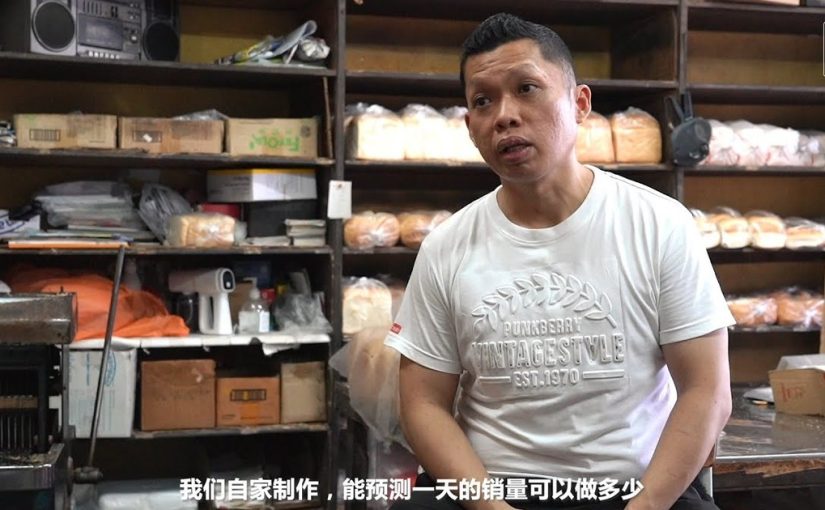
Located at Jalan Pudu in Kuala Lumpur, Southern Bakery is established for over 60 years, the only long-standing bakery in Pudu area, containing many locals’ unforgettable memories linked to childhood favourite foods. While baking, the bread aroma flows throughout the shop, attracting the attention of passer-bys. Regular customers would linger around the shop in advance, so that they could purchase the bread freshly out of the oven. As “spring bread” is rarely seen nowadays, most customers forgotten about its existence. Some customers come across it by chance and bought a few due to indulging in reminiscence.

The unique appearance of “spring bread” brought upon various nicknames: pillow bread, lantern bread, or bamboo-shaped bread, thanks to the customized cast-iron tins. The tins were purchased during the British colonization era by the founder Mr Han Chok Toon, extremely durable considering their daily usage for decades. The shaped bread dough is inserted into the two-cavity bread tin, then covered and bolted to bake. After that, the tin is unbolted and gently tapped on the workbench to release the bread. The handful of such tins in Southern Bakery are rare and precious, bearing witness to the past while continuing the legacy of “spring bread”.

The current second-generation owner Auntie Han Jee Nee is born into a family of bakers. Her grandfather ran a bakery in Singapore, and her parents used to help in the family business until mid-1950’s, when they moved to Pudu and founded Southern Bakery at Jalan Pasar together with two partners. Apart from “spring bread” made in cast-iron tins, the bakery also offers down-to-earth Hainanese bread, fist-sized plain buns, and French baguette etc. Their widely popular signature coconut bun is filled with freshly desiccated coconut, without any trace of palm sugar, a secret recipe passed on by Auntie Han’s mother.

In the earlier days, due to the bakery’s close proximity to Star cinema, Metropole cinema, and Majestic cinema, when movie showtimes are over, the bakery was crowded by people buying bread for their next day’s breakfast. At its prime during the 1960’s-70’s, there were 12 staff rotating through morning and night shifts to produce freshly made bread, which were not only sold in the bakery, but also through food trucks and hawkers, and supply to hotels and restaurants. In 1993, Auntie Han and her husband Uncle Law Hong Cheng took over the reins from her ageing father, who passed away the following year.

As more chain bakeries entered the scene in Kuala Lumpur, customers are attracted by fancy gimmicks, packaging and designs. Even so, Auntie Han and Uncle Law did not choose to take a radical approach. Instead, they focus on maintaining the quality of their breads, persisting in producing true authentic flavours. Initially the bakery only offers a few types of bread, until the addition of red bean buns, butter buns, chicken floss buns, and peanut buns in recent years due to customer demands. Currently they work on a small scale, only baking once per day, therefore the quantity of bread produced is very limited, especially “spring bread”.

Auntie Han and Uncle Law took scrupulous care of Southern Bakery for decades, although their business model is getting outdated, they remain calm despite the challenges. Business expansion is not easy, requiring experience, labour, and sufficient capital. Taking things easy, they keep their selling prices low and affordable, hence customers in the neighbourhood continually support them. When they relocated from Jalan Pasar to Jalan Pudu in 2015 due to rental issues, regular customers have no trouble tracing their whereabouts.

Nestled in a busy city, fast-paced lifestyle and immense social pressure did not cause negative impact to Southern Bakery. Auntie Han and Uncle Law tranquilly enjoy a slow-paced lifestyle, and keep on producing simple handmade traditional breads. Focus on the good, and stay happy.

Southern Bakery
03-9221 5781
No. 393, Jalan Pudu, 55200 Kuala Lumpur

Text: Daniel Lim & Pua Hui Wen

有你 UNI Production
Producer : Mok Yii Chek
Coordinator : Daniel Lim
Cinematographer : Amelia Lim / Evon Pang
Video Editor : Evon Pang
Production Assistant : Michael Lerk
Music : Atmospheric Inspiring Piano

COPYRIGHTS 2020 ECHINOIDEA SDN BHD

☕ Buy Us Coffee