The Dedication of Merits

The sounds of cymbals, drums and suona accompanied Taoist prayer chanting, around 100 members of the Hau family gathered together at their ancestral house in red mourning attire, burning incense and kneeling to pray under the guidance of five Taoist priests. Through joint effort over several months, the entire family organized a commemoration ceremony in conjunction with the third death anniversary of the late old Mrs Hau. The 30ft joss paper house is dedicated to eight deceased relatives.

In traditional Chinese beliefs, a deceased person’s soul would depart to the Underworld, where they would pass through the Ten Courts of Judgement. Even if a person always did good deeds while alive, there might be unintentional mistakes for which they were punished. Descendants will engage Buddhist monks or Taoist priests to facilitate merit dedication rituals to help their ancestors atone for past misdeeds thus achieving enlightenment.

The head of the household is 69-year-old Hau Kim Heng, whose grandfather hailed from Nan’an, China yet eventually settled in Sungai Rambai, Melaka, where the family prospered and spread across different regions in Singapore and Malaysia. Hau Kim Heng used to work at Singapore in the construction industry, then he returned to the ancestral home to take care of his ageing parents until they breathed their last. His mother passed away peacefully at the ripe old age of 93, with five living generations, therefore a ‘Joyful Funeral’ was held where all the family members wear red mourning clothes.

The dedication of merits is very important in the Hokkien community, the late old Mrs Hau also commended the practice, therefore Hau Kim Heng and siblings decided to throw a grand ceremony in honour of their beloved mother. The dedication of merits usually spans three days, smaller occasions merely 24 hours, yet the Hau family decided on a large scale event spanning five days. The full itinerary comprises ‘soul summoning’, four sessions of prayer chanting held in the morning and at night, request for pardon, destroy city walls, morning assembly, repayment of treasury debts, appease roaming spirits, and dismantle the joss paper house. Last but not least is burning the joss paper house and give thanks to the Jade Emperor.

The leading Taoist priest for the Hau family’s dedication of merits, Haw Eng Thian, is a Zhengyi Taoist affiliated with Mount Longhu in Jiangxi, China. After ordination, he goes by the monastic name Hóu LuóZhǎn. Although just in his forties, he spent almost 30 years in the profession. Both Haw’s father and maternal great-grandfather are Taoist priests, he sparked a keen interest since the tender age of 10, following his father to attend various ceremonies on weekends and holidays, lending a helping hand while learning basics such as drumming, rhyme and rhythm in prayer chanting. Haw started out upon leaving school after Form Two, by the age of 20 he is capable of handling small to medium-scale ceremonies, therefore his father handed over the reins to him. 

At the beginning of his career, Haw handled mostly small to medium-scale ceremonies, where neighbours would assist the host family in preparing offerings and meals. However, community bonds weakened with the passing of the older generations, such tasks had to be outsourced to service providers and food caterers. As a Taoist priest, Haw tries his best to accommodate various requests by different host families. Sometimes he has to travel to two or three venues in a day, his passion alleviating the fatigue as he does his best to fulfill his duty at each ceremony.

The dedication of merits not only commemorates deceased ancestors, it also strengthens family bonds, as well as continuing the legacy of cultural customs. By properly performing each ritual, paying respects to ancestors while inducing younger generations to uphold moral obligations, complete virtue is achieved.

.

[Soul Summoning]

The Taoist priest paves the way to the Underworld, using a soul-summoning banner to invite the souls of deceased ancestors to their respective memorial tablets. Each soul-summoning banner bears the name of a deceased, attached to the tip of a long thin bamboo stick, carried by the eldest son or eldest grandson. If the deceased had no offspring, a nephew would do.

[Five Elders Lead the Way]

Inviting the Five Celestial Elders and Five Immortal Boys to serve as guides for the deceased.

Five Celestial Elders: Green Emperor of East, Red Emperor of South, Yellow Emperor of Center, White Emperor of West, Black Emperor of North

Five Immortal Boys: QīngLíng Boy of East holds a green lotus, JīnHuī Boy of South holds a red lotus, ZhēnJué Boy of West holds a white lotus, KaīMíng Boy of North holds a blue lotus, MiàoGuāng Boy of Center holds a yellow lotus. They greet the deceased soul and serve as heavenly guides.

[Prayer Chanting]

The Taoist priest leads the family in prayer chanting: 10 scrolls of 《Precious Litanies of Nine Realms of Darkness》, three scrolls of 《Precious Repentances to the Three Primes》, and 《Scripture on Salvation》. At the conclusion of each scroll, the soul-summoning banner is raised and respects paid to deceased ancestors.

[Request for Pardon]

Apart from prayer chanting and delivering speeches, Taoist priests would act out various scenes, including meeting with the pardon attorney to implore his service in requesting for a pardon letter, feeding the joss paper horse on which the pardon attorney would ride as fast as he could to the Underworld, and pleading with the ruler of the Underworld to grant pardon.

[Destroy City Walls]

Also known as “Rescue from Hell”, based on the Classic of Filial Piety where Mulian rescues his mother from the Underworld. The Taoist priest leads descendants to travel around an octagonal city constructed of joss paper, explaining each checkpoint along the way, then the city walls are destroyed in order to free the deceased ancestors from suffering in the Underworld.

[Morning Assembly]

Offering tea and liquor as a token of gratitude to the presiding deities.

[Repayment of Treasury Debts]

Repaying the loans obtained for reincarnation according to the deceased’s Chinese zodiac. During the burning of treasury banknotes, descendants should keep banging metal objects to scare away roaming spirits from committing robbery. 

[Appease Roaming Spirits]

The host family prepares food and paper offerings to appease roaming spirits.

[Dismantle Joss Paper House]

On the final night of the ceremony, the joss paper house is dismantled and burned, marking the end of the mourning period.

有你 UNI Production
Producer : Daniel Lim
Cinematographer : Amelia Lim / Evon Pang / Michael Lerk
Drone : Daniel Lim
Video Editor : Evon Pang
Copywriter : Pua Hui Wen

COPYRIGHTS 2023 ECHINOIDEA SDN BHD

Buy us coffee

Deities Procession at Yuè Shān Gǔ Miào in Kuala Kubu Bharu

In the wee hours of the morning, a number of Kuala Kubu Bharu village residents are busy preparing a tableful of offerings in front of their house, gathering on the roadside to look around in anticipation. As the sun breaks through the clouds, drumming and firecrackers crackling fill the air, about a thousand devotees throng around Yuè Shān Gǔ Miào where the Shī Yé patrol procession begin, heading into each and every alley of the local village to shower blessings, and then the town before returning to the temple. The entire route measures about seven kilometres. Along the way, devotees kneel and pray to the deities for protection over their families, as well as exchanging incense and offerings with the procession.

The main deities of Yuè Shān Gǔ Miào are the Third Shī Yé and Fourth Shī Yé, Third Shī Yé being Kapitan Shin Kap alias Kapitan Sheng Meng Li, the Kapitan of Sungei Ujong or Seremban who was worshipped upon his demise in war; Fourth Shī Yé being Chung Lai, a commander who fought together with Yap Ah Loy and lost his life in the Selangor Civil War. As a memorial to the two late Hakka leaders who fought hard to protect the community, they were venerated in the same temple by Yap Ah Loy. Eventually a religious cult was established by the Hakka clan in Malaya, which later on spread to various settlements, watching over the development of tin mining towns.

Yuè Shān Gǔ Miào was built in 1895, overlooking and safeguarding the village and town of Kuala Kubu Bharu. Initially Kuala Kubu in Ulu Selangor, the town was founded on tin mining and rubber cultivation. Six decades ago, disaster befell the town, after consultation with deities, Shī Yé went on a patrol procession to drive away evils therefore restoring peace. Since then, the procession became a triannual event held on the 15th day of the second lunar month, with a three-day ritual ceremony.

The current president of the organizing committee, Mr Tan Tek Son, who grew up in Kuala Kubu Bharu and is now 77 years old, has been handling temple affairs for over half a century, thus very familiar with the procedures. Preparations start one month in advance due to tedious and time-consuming aspects, volunteers turn up to help in scrubbing altars, polishing censers, folding joss papers, cleaning and re-assembling wooden sedan chairs. On the procession day itself, some even come as early as 3A.M. to cook vegetarian fare for attendees. 

What catches the eye most is the “Iron Throne” – a wooden sedan seat lined with sharp nails. A week before the procession, the temple lets interested spirit mediums perform moon block toss, whoever wins the most approvals from Shī Yé gets assigned. In olden days, the customary practice was getting spirit mediums to stay overnight at the temple, Shī Yé will decide on which candidate prior to the procession, however in recent years this practice was overridden by moon block toss to show fairness.

The procession is led by gong, drums, lion dance, and the Marshals of Five Celestial Camps, then comes the “Iron Throne”. This year’s assigned spirit medium is 61-year-old Mr Yap Swee Lin, who after being possessed by Shī Yé sat steadily upon the “Iron Throne” while brandishing a sword, maintaining a calm countenance despite the constant jolting. The censer as well as tables laden with offerings followed right after.

Bringing up the rear are the two sedan chairs of Shī Yé and Guān Yīn respectively, with Shī Yé’s borne by male devotees while Guān Yīn’s borne by female devotees, followed by spirit mediums and devotees with their cheeks pierced by needles. Devotees who encounter misfortune may request to kneel under the sedan chair for luck. 

Shī Yé worship is founded on a collective need for peace, security, and health. The triannual procession is not on a large scale, yet in the small town it is considered a grand event. By the means of a patrol procession, the deity showers blessings upon local residents, who found spiritual ease, as well as promoting community bonds and cultural heritage.

有你 UNI Production
Producer : Daniel Lim
Cinematographer : Amelia Lim / Michael Lerk
Drone : Daniel Lim
Video Editor : Michael Lerk
Copywriter : Pua Hui Wen

COPYRIGHTS 2023 ECHINOIDEA SDN BHD

Buy us coffee

Master Yap Hong Ngee: “Eternal Love” Oil Painting Exhibition

Ascend the escalator onto the 4th floor of GMBB creative community mall, a vast array of rose oil paintings adorn the long exhibition hall. Taking centre stage is a small artwork which consists of roses in the three primary colours and adequate blank-leaving within a gold leaf frame, entitled “Eternal Love” as written on a card placed at the bottom-right. Renowned local artist Yap Hong Ngee adopted it as the theme of his solo exhibition, spreading the power of love.

About 150 pieces of rose oil paintings bedeck contiguous exhibition spaces within the entire floor. Laid out in the style of an art gallery, the artworks are arranged in surprising ways, including forming polyptychs. A myriad of roses bloom in every corner, symbolizing all sorts of love, with white standing for purity, pink for affection, red for passion, yellow for warmth, blue for mystery. Walking around the gallery while holding a loved one’s hand is as if taking a walk in a romantic rose garden. Upon stopping to admire artworks, lean in to gently whisper “I love you.”

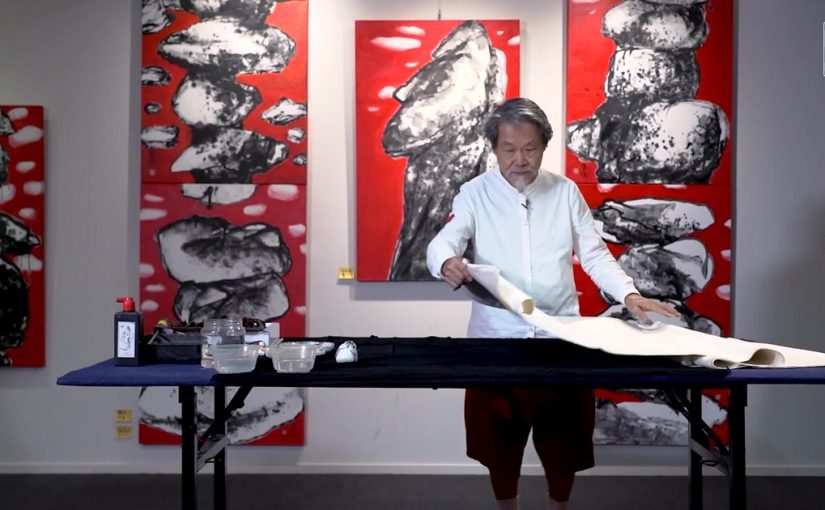
About 30 years ago, Master Yap started painting roses for Valentine’s day event at a Japanese department store. Even though the partnership ended years ago, he keep on producing rose oil paintings. Despite being known for Chinese ink painting of sparrows, Master Yap chose Western oil painting as the medium to paint roses which are prominent in Western countries for better interpretation. His rose paintings are by no means realistic, but rather an impression painted in the style of Chinese ink painting after close observation and fully understanding the nature of roses.

Master Yap’s painting process is quite straightforward, squeezing oil paint directly onto the canvas without sketching or using a palette, creating a vivid blooming rose in one stroke. The patterns range from swirls to ripples, unconstrained yet retaining the nuances of a rose, recognizable by the beholder. Apart from that, the artwork titles prompt viewers to contemplate their meanings, relating to their own past experience and resonate with the artist’s ideas.

As the proverb goes: “The rose’s in her hand, the flavor in mine.” A seemingly ordinary action leaves a warm impression on both parties. Perhaps due to Master Yap strongly valuing interpersonal relationships, he incorporates his life experience into his paintings, the sincerity touches the hearts of viewers, bringing people closer together. During art exhibitions, Master Yap would meet complete strangers who were brought to tears by his paintings and shared their life stories with him, thus becoming fast friends.

Master Yap is turning 80 years old, yet he is full of enthusiasm, obtaining great enjoyment in painting. In future, he intends to continue holding exhibitions, hopefully getting the chance to tour different cities and states. For one thing, he wish to let friends know that he is still actively painting. For another thing, he wish to make new friends via artworks and exchange ideas. Master Yap does not place emphasis on selling his paintings or receiving praise, and does not mind whether his artworks are being liked or disliked. To him, true happiness is the feelings of love and support, which enabled him to persist in painting.

有你 UNI Production
Producer : Daniel Lim
Cinematographer : Amelia Lim / Michael Lerk
Drone : Daniel Lim
Video Editor : Amelia Lim
Copywriter : Pua Hui Wen

COPYRIGHTS 2023 ECHINOIDEA SDN BHD

Buy us coffee