Joss Paper House

Standing at 21ft tall and 24ft wide, the joss paper house is built on a grand scale according to traditional Mǐnnán architecture layout, featuring ornate decorations. The frame is made of bamboo slivers tied together using paper strings, layers of vivid coloured paper are pasted as walls, balconies, and pavilions. Illuminated by colourful LED light strips, the entire joss paper house sparkles. In traditional Chinese beliefs, a deceased person’s soul would depart to the Underworld, therefore the Hokkien clan would dedicate comfortable joss paper houses to their dead relatives. 

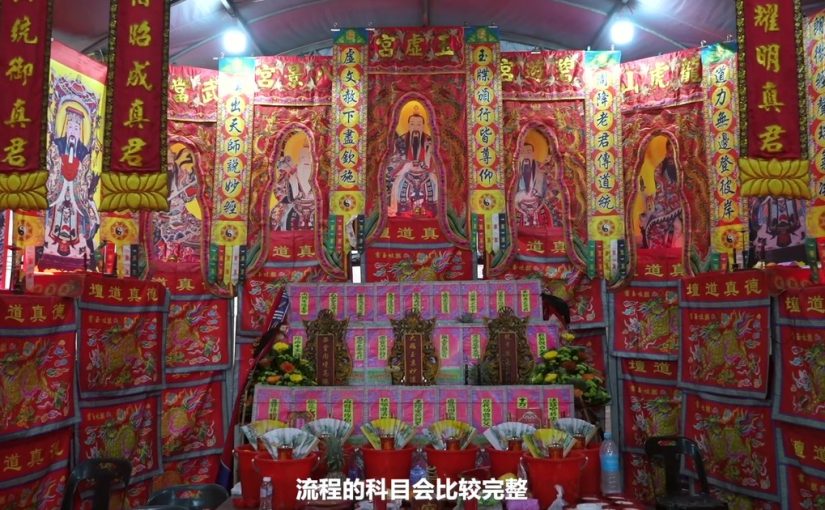
Hokkien ancestor veneration revolves around filial piety. As a tribute to deceased parents, to mark the end of the three-year mourning period, the bereaved family would engage Buddhist monks or Taoist priests to facilitate merit dedication rituals to help their ancestors achieve enlightenment. Legend has it Emperor Taizong of Tang dynasty visited the Underworld in a dream, upon returning to the mortal world he organised merit dedication rituals for departed souls to atone for past misdeeds thus achieving enlightenment. Apart from joss paper houses, there are also gold and silver mountains, servants, sedan and carriages etc. are burned as offerings.

Toh Chooi Heng from Jenjarom has almost four decades of experience in crafting joss paper offerings, expertising in joss paper houses and Jade Emperor thrones (for use in Jade Emperor birthday celebration on the ninth day of the first lunar month). He has been helping his uncle crafting joss paper offerings since he was 11 years old, mastering the skills along the way. Having attempted various unsuccessful ventures during his youth, he returned to crafting joss paper offerings. As Toh settled his mind and paid full attention to his work, he patiently crafted elaborate and intricate joss paper houses. Even though the entire process is time-consuming and production capability is limited, he insist that the deceased should reside comfortably in an extravagant Underworld residence.

Toh’s joss paper houses are constructed in accordance with classic Mǐnnán folk dwellings, extending from the main hall in the center to symmetrical left and right wings, connecting to each other via corridors. The central courtyard is surrounded by rooms on all four sides: the South hall, the North hall, the East chamber, and the West chamber. The South hall is annexed to the gate, then comes the courtyard, where the East and West chambers sit on either wing. The North hall consists of major bedrooms and living space.

The topmost point of the joss paper house is the balcony, which offers moonlight view. Each storey is adorned with paper effigies symbolizing good fortune, such as Top Scholar Street Parade, Nezha rampages across the East Sea, the Eight Immortals etc. Furthermore, the 24 instances of filial piety are depicted, in the hopes of descendants continue to uphold virtues. The main entrance occupies the middle spot, winged by gardens and ponds, with arched bridges and ten pavilions.

The fundamental skill of crafting joss paper houses is to tie bamboo slivers using paper strings, which is harder than it looks, requiring ambidextrous coordination to build a solid frame thus preventing structure failure. Upon mastering this skill, one may move on to learn to construct paper columns proportionate to the building’s dimensions. Next up is the basic layer of white paper, on which coloured paper is pasted, then seal the corners. Sections of the joss paper house are completed separately, piled onto a lorry for delivery to the ritual altar to be assembled on the spot and to add on the paper effigies.

Advancing technology gave Toh the idea of illuminating joss paper houses with LED light strips. He does not stick firmly to tradition, but is open to creativity challenges. If customers decided on a joss paper bungalow, he is able to create a replica based on photos provided by customers. The scale dimension of a joss paper house is subject to spatial constraints, i.e. adequate space for open burning. Due to the time-consuming process of crafting joss paper houses and thereafter assembling at the ritual altar, Toh needs to estimate delivery time carefully in order to prevent double-booking himself, since he is unable to be in two places at the same time.

Even though their forebearers emigrated overseas a century ago, traditional cultural values such as ancestor veneration are still embedded within the Malaysian Chinese community, and traditional mortuary rituals are still being practised. Toh Chooi Heng observed that as times change, traditional rituals are getting simplified, traditional trades such as crafting joss paper offerings might slowly die out. However he feels optimistic as current market competition positively influence fellow craftsmen to produce higher quality handiworks, instead of the other way round.

有你 UNI Production
Producer : Daniel Lim
Cinematographer : Amelia Lim / Evon Pang / Michael Lerk
Drone : Daniel Lim
Video Editor : Amelia Lim
Copywriter : Pua Hui Wen

COPYRIGHTS 2023 ECHINOIDEA SDN BHD

☕ Buy Us Coffee

Pertama Electronic Services

Power supply boards, printed circuit boards, and transistors are puzzles levels to be solved, screwdrivers and soldering irons are handy weapons, while copper wires and various spare parts are regular inventory items. To father-son duo Chiew Soon Foo and Chiew Chin Hong, repairing domestic appliances is an exciting game, to clear levels with all stars is an achievement they intently seek. From large appliances like televisions, speakers, to small appliances like rice cookers, clothes irons would all be taken apart for a thorough inspection, faulty parts are then repaired or replaced, and the appliances would be in good working order after reassembling. 

Heading southwards from Klang on the Federal Route 5, passing by Jenjarom, a giant bridge over the Langat river connects to the streets of Banting. Banting is the principal town of Kuala Langat district, having developed from farmland to an agricultural and industrial hub within the past century, its main street is bustling with traffic. Pertama Electronic Services occupies a double-storey shophouse facing the main street, its predecessor being a grocery store founded by Chiew Soon Foo’s grandfather upon settling in Malaysia, hence the wooden signage bearing “Tuck Heap Huat” above the entrance.

Since his childhood, Chiew Soon Foo stayed on the second floor of the shophouse. After his grandfather passed away, his father took over the reins of the grocery store. Having completed Form Three, Chiew Soon Foo dropped out of school, working at a furniture manufacturer during the day while studying electrical and electronic repairs at night. Upon completion of his diploma, he worked at Klang for six years before returning to Banting to start his own business. In the beginning, Chiew Soon Foo took up a corner of his father’s shopfront, and went performing on-site services around neighbouring villages. He gradually made a name for himself, customers would send their appliances to the shop for repairs, as well as refer him to their friends and family. Since the grocery business was going downhill, after clearing out the inventory, the shop officially became a repair store. 

Shelves and tables inside the shop were handmade by Chiew Soon Foo with his furniture manufacturing skills, whereby at home he is in charge of all maintenance and repairs. All along, Chiew Soon Foo works together with his wife and son, without hiring helpers. His wife, See Pey, who has no prior knowledge, went on to become a steady assistant, from coiling copper wires, soldering, to reassembling appliances. His son, Chiew Chin Hong, who sparked a keen interest since a tender age, joined him in the repair shop after graduating from school. Together they continually explore, practice, and master progressive skills in repairing electrical appliances. 

Electrical technicians make a living using their skills, charging fees which include parts, materials, and labour, yet may not be profitable. The Chiew father and son will negotiate prices with customers, the repair job will only be carried out upon achieving a mutual agreement. From finding the faulty parts to completing repairs or replacements, the entire process usually take two to three days. If the parts are hard to come by, which requires sourcing online, it will take a longer time, even without taking into account that the parts ordered online might not be suitable. Certain antiquated parts have been discontinued and therefore could not be replaced, in such cases Chiew Soon Foo is powerless despite his talent in appliances repairs. 

Back when supplies were scarce, domestic appliances were rare and precious, repairing was more cost-efficient than buying a new one. Nowadays domestic appliances have became daily necessities at affordable prices with a warranty period. In case of faulty or damage, most would opt for making a new purchase rather than sending for repairs. Chiew Soon Foo laments that discarding broken appliances is not environmentally friendly, to repair is a sustainable practice which may extend their lifespan as well as reduce e-waste. If customers no longer want their appliances back, Chiew Soon Foo will retain usable parts and send the remaining to registered collection facilities.

Cathode-ray tube televisions and radios, cassette players, videocassette recorders were rendered obsolete by advancing technology, and cannot be repurchased once discarded. Some may retain them for the sake of nostalgia, even though they have fallen into disuse. Through the magical skills of a repair technician, they might once again be in a usable condition, so why not?

Pertama Electronic Services is Chiew Soon Foo’s pledge to put in patience and effort to achieve the best outcome. The family of three enjoy working together, to them, life is always fun and never boring.

有你 UNI Production
Producer : Daniel Lim
Cinematographer : Amelia Lim / Evon Pang / Michael Lerk
Drone : Daniel Lim
Video Editor : Amelia Lim
Copywriter : Pua Hui Wen

COPYRIGHTS 2022 ECHINOIDEA SDN BHD

☕ Buy Us Coffee

Ko Hou Kam Herbal Tea in Mambau

Ko Hou Kam herbal tea, the first sip fills the mouth with bitterness, yet yields a lingering sweetness once it slips down the throat, hence its name meaning sweetness after consumption. A nationwide popular beverage back in the 90s, Ko Hou Kam advertisements were aired on various television stations, and even distributed abroad. With a superfluity of health drinks available nowadays, Ko Hou Kam eventually diminishes, and can only be found at certain traditional Chinese medicine store or its place of origin – Mambau.

Mambau is a small town on the outskirts of Seremban, Negeri Sembilan. At the beginning of the 20th century, as the rubber industry flourished, large-scale plantations were developed in Mambau. The village was established in the 50s, the majority of the 200 households were rubber tappers. Due to its strategic geographical location, the rail freight route from Port Dickson pass through the border of Mambau village (now demolished), and so does the Federal Route 53 linking Seremban and Port Dickson. Before the construction of Seremban–Port Dickson Highway, Federal Route 53 is the main road leading to Port Dickson, tourists usually stop by Mambau for rest and refreshments.

Located just off the main road, Mambau Khek Yong Tau Fu may have a shabby appearance, however it is the birthplace of Ko Hou Kam herbal tea. The founder, the late Mr Kum Loong Poh, used to work in the construction industry. However, business failure due to the global economic recession of the early 1980s caused him to seek new opportunities in the food and beverages industry. In order to finance the household, Mr Kum worked long hours till the point that he suffered from health complications. After consuming a herbal tea prepared according to a prescription which his ancestors brought over from China, his condition improved. Since the herbal tea has proven health benefits, Mr Kum decided to promote it so that others can enjoy improved health too.

The original herbal brew has a bitter aftertaste, therefore the late Mr Kum Loong Poh researched and developed an ideal herbal tea formula suitable for general consumption as well as offering a lingering sweetness. The main ingredients of Ko Hou Kam herbal tea are camellia, silver needle, and chrysanthemum. Silver needle tea leaves are subjected to processing in order to neutralise acidity: sun-dried after being harvested, stems removed, and the tea leaves are then fermented for 100 days. Ko Hou Kam herbal tea comes in individually sealed tea bags for ease of consumption.

Ko Hou Kam herbal tea was initially sold in Mambau Khek Yong Tau Fu as well as a friend’s coffee-shop. Back then, the health drink market just started to grow, imported health drinks were expensive, and there were barely any local manufacturers. Mr Kum Loong Poh’s savviness in launching Ko Hou Kam herbal tea at an affordable price instantly gained market popularity, hitting the shelves of medical stores as well as being distributed nationwide. As manual packaging became inefficient due to increasing demands, he set up a small factory and invested in an automated packaging system to ease operations and storage.

After the passing of the late Mr Kum Loong Poh, his sons Kum Han Soon and Kum Han Loong took over the operations of Mambau Khek Yong Tau Fu and Ko Hou Kam, thus prevented disappointing regular customers. However, intensifying market competition led to business decline, structural market changes dealt another severe blow – younger generations prefer to consume unhealthy beverages such as bubble milk tea, only a few would appreciate herbal tea. Even so, Kum Han Loong did not give up, but turned to taking phone orders and online marketing to explore new opportunities.

The Kum brothers are born and bred in Mambau, plus Ko Hou Kam was founded by their late father in this small town, tight bonds flourish within the local community, therefore they chose to stay in their hometown to carry on the family business. Nevertheless, herbal tea is not some magical remedy. Kum Han Loong gently reminds everyone not to simply rely on herbal tea for health benefits, but to combine with regular exercise, maintain a daily routine, and eat a balanced diet, living a healthy lifestyle to keep the mind and body fit.

有你 UNI Production
Producer : Daniel Lim
Cinematographer : Amelia Lim / Evon Pang / Michael Lerk
Drone : Daniel Lim
Video Editor : Evon Pang
Copywriter : Pua Hui Wen

COPYRIGHTS 2022 ECHINOIDEA SDN BHD

☕ Buy Us Coffee