Cendol in Simpang Renggam

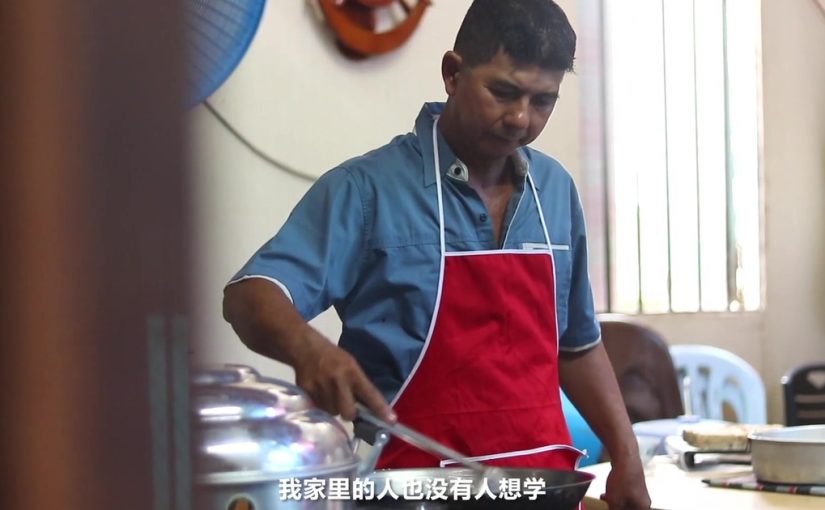
Within the row of shophouses beside Simpang Renggam main street, there is a Cendol stall popular with local residents —— Gerai Cendol Sathar. Under the blue canopy, stall owner Ahmad bin Sathar is busy making bowls of snowy fine shaved ice with the ice-shaving machine, topped with fresh green Cendol, brownish Gula Melaka sauce and rich Santan sauce. Among the colourful condiments are maroon candied red beans, pink Sago, golden corn in evaporated milk, as well as the option to add on glutinous rice according to personal preference. All ingredients are made in-house, prepared fresh daily, widely praised by customers and attracts people from near and far.

Sathar Cendol stall operates in the same spot since its establishment, never since relocated. The stall is set up between two shophouses, coincidentally an alley lies behind, therefore simple tables and chairs are placed in the vicinity for customers to be seated while waiting, as well as enjoying the exquisite sweet Cendol. Local residents and neighbouring shop owners achieve a tacit understanding not to drive or park their cars into the alley. A special sentiment flows through this alley, the rustic shaved ice containing fond memories of local residents who enjoy the delicacy since young.

Cendol is a type of jelly made from a mixture of extracted Pandan leaf juice and rice flour, naturally green in colour, originating from Java, Indonesia in the form of a beverage. Cendol has a mellow Pandan taste and a smooth texture, combined with shaved ice, Gula Melaka sauce and Santan sauce for a fresh and cool mouthfeel. In Malaysia’s perpetual summer, it is nice to be able to enjoy a bowl of icy Cendol anytime. Not only is Cendol popular throughout Malaysia, there are also a variety of condiments and eating methods, such as adding in peanuts, cashew nuts, attap fruit, jackfruit, ice-cream, or even durian.

Under the blazing sun, the heavily perspirating Ahmad bin Sathar is currently the fourth generation successor of this family business with over 60 years of history. Ahmad’s great-grandfather migrated to Penang from India during the olden days to seek employment, and learnt the trade from a Javanese. Back then he carried the equipment and condiments on a shoulder pole, selling door-to-door in the villages of Penang to Prai. Afterwards, Ahmad’s grandfather succeeded this trade and went selling Cendol in Teluk Intan, Perak. As he passed away, the third generation successor Sathar, who is Ahmad’s father, shifted southwards to settle down at Simpang Renggam in 1956, establishing his stall with the family trade by selling Cendol on a tricycle.

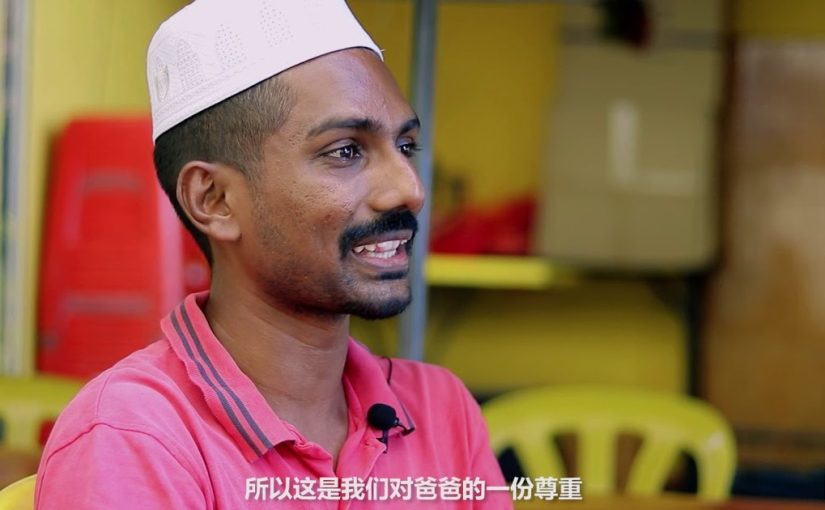
To make a living in a foreign place is not easy, however generations of Sathar’s family survived and provided for their family with the craft of making Cendol. Sathar perseveres in his only familiar skill, refusing to be underestimated due to being self-employed. Apart from raising ten children, he even managed to open his own Mamak store (Restoran Usaha Berkat). Reminiscing being questioned by government authorities whether he could afford the monthly loan repayment of RM2500, Sathar merely smiled, notwithstanding his bitter struggles where nobody bears witness to. As Sathar’s sons (Ahmad and his brother) succeeded his business, they retained the original stall name out of respect to their father.

The essence of grass-root spirit is tenacity and independence, like a blade of grass, rooted firmly and standing tall even though weather-beaten. Just like Sathar’s family, undeterred by difficulties, working hard to make a living by selling bowls of delicious Cendol.

Text: Daniel Lim & Pua Hui Wen

有你 UNI Production
Producer : Mok Yii Chek
Coordinator : Daniel Lim
Cinematographer : Amelia Lim / Evon Pang
Video Editor : Amelia Lim
Production Assistant : Michael Lerk
Music : Twinkle In The Night

COPYRIGHTS 2019 ECHINOIDEA SDN BHD

☕ Buy Us Coffee

Fú Zhōu Red Rice Wine with Vinasse

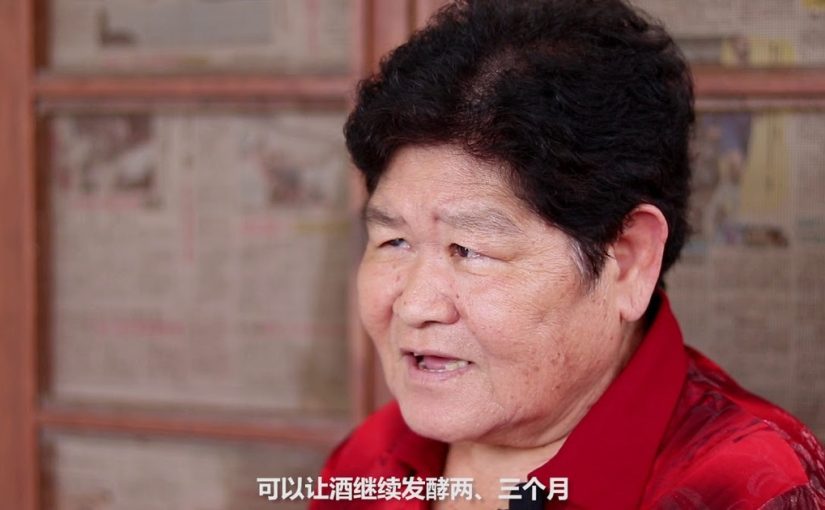
In the kitchen at the rear end of the house, the floors are lined with newspapers, the pestle and mortar making crisp sounds while pounding. Grandmother Yap Ah Hwa (transliteration) woke up before dawn, busying herself with preparing ingredients to make red rice wine, from her energetic and smooth workflow it’s hard to discover that she is already 72 years old. This is the red rice wine which every single FúZhōunese household brew on their own, an indispensable ingredient in preparing Fú Zhōu dishes, its unique mellowness a key factor in complementing aroma and taste, coating food with a rosy tint, and also symbolizing good luck during festivals. The familiar native taste did not fade away with migration, instead it increased unity, as well as spreading the intense love for red rice wine to community members from other nativities.

Fú Zhōu red rice wine is a type of Chinese rice wine, made up of three simple ingredients: wine yeast cake, cooked glutinous rice, and specialty red yeast rice produced in the Mǐn region in China. The ingredients are mixed together and inserted into an urn, storing in a cool shaded place for the lengthy brewing process. At the end of the fermentation cycle, the liquid extracted from filtration is red rice wine, and the final residue is called vinasse. Red yeast rice is a type of fermented rice which acquires its colour from being cultivated with the mold Monascus purpureus, with health and nutritional benefits in traditional Chinese medicine of promoting digestion and improving blood circulation.

FúZhōunese make up the majority of the population in Chuah, Negeri Sembilan, where every household withholds the custom of brewing red rice wine by themselves, however the recipes and methods used may differ. Some families will insert the ingredients layer by layer; some add in water; some will add red yeast into rice wine and mix evenly; the length of fermentation also ranges, and the resulting taste varies. Grandma Yap (transliteration) who lives in Kampung Baru Sungai Nipah is particular in the ingredients she uses in brewing red rice wine, ensuring good quality and rich taste, which her family and friends enjoy. Initially, the red yeast rice and wine yeast cake are sun dried and finely pounded in advance, the urn being repeatedly washed and thoroughly dried. When brewing red rice wine, the glutinous rice is cooked and let cool overnight. The next day, all ingredients are mixed evenly, poured into a canvas bag, and tied up tightly. Then the urn is sealed and kept in a cool dry place to ferment for at least 75 days.

When she was young, Grandma Yap (transliteration) learned by asking relatives and friends for advice and doing research, experimenting on her own, never once slacking during the preparation and brewing procedures, therefore her brewing method is extraordinarily successful with a high yield. After fermenting for two months and a half, she could reap ten bottles of red wine, compressing the vinasse till it dries up, without wasting even one drop of red wine, and finally keeps the vinasse. Luck is crucial in brewing red rice wine, depending on favourable conditions for a smooth and successful brew. Some people who are having bad luck will be unsuccessful in brewing, or the yield is low and tastes bad. Other precautions and instructions include: from preparing ingredients, to sun drying the urn to expel residing flavours; some are beware of people who attended funerals, pregnant women, women in their confinement, or menstruating women from approaching the red rice wine they brew.

Embarking on a tipsy culinary journey, experiencing an intoxicating lesson in cultural customs. Over the decades, Grandma Yap’s red rice wine became a familiar and unforgettable fondness of her family, an essence of blended native cultures. Treating family and friends to red rice wine during festive celebrations, using vinasse to cook a table full of reddish Fú Zhōu dishes such as red wine chicken and mee sua, red vinasse pork etc. Acquiring the skills of brewing red rice wine could bring about the continuity of Fú Zhōu dishes over several generations.

Text: Daniel Lim & Pua Hui Wen

有你 UNI Production
Producer : Mok Yii Chek
Coordinator : Daniel Lim
Cinematographer : Amelia Lim / Evon Pang
Video Editor : Amelia Lim
Production Assistant : Michael Lerk
Music : White River

COPYRIGHTS 2019 ECHINOIDEA SDN BHD

☕ Buy Us Coffee

Fú Zhōu Lard Cakes

The nutty aroma of peanuts, paired with the rich aroma of lard, and a thick mouthfeel, the almost extinct lard cake was a must-have specialty dessert in Fú Zhōu banquets. Within 15 minutes by car from Bukit Pelanduk, at the rear of a sky blue wooden cottage in the village of Tanah Merah Site C, Mr Chong Teck Fong (transliteration) could be sighted busying himself in the kitchen, attentively crafting traditional lard cake. Lard cake, also known as Manchuria cake, is a Fú Zhōu treat made from a mixture of lard, peanuts, sugar, and flour. It is also commonly found in Sitiawan, Perak and Sibu, Sarawak, however the preparation methods and mouthfeel may differ.

In the mid-18th century, the Manchuria Eight Banners army were garrisoned at Fú Zhōu, leaving a plethora of snacks and treats, among them is lard cake, which was rumoured to be a royal dessert. Migrating from Yún Nán, China to Malaysia, Mr Chong’s father mastered the skills of making lard cake in his hometown, even though he set up a swine farm in Malaysia, he continues the craft in supplying banquets, gaining fame due to the familiar native birthplace taste.

The process of making lard cake is complicated and time-consuming, stressing on the quality of ingredients as well as the skills of the chef, requiring at least two days to complete. The ingredients include lard, flour, sugar, peanuts, sesame, and egg, slowly mixed together, poured into a wooden mould, and then steamed. Nowadays, the production of lard cake found in other regions rely on machinery, even substituting lard with vegetable oils, resulting in a shriveled oily cake. Reluctant to affect the mouthfeel and quality of lard cake due to the crude production process, Mr Chong persists in genuine handcrafting, without involving machinery.

First of all, lard is scraped off the pork flesh, cut into small cubes, stir fry and season, mix evenly, add in flour, rub into a paste, then add in sugar to maintain a thick mouthfeel. Peanut is the most laborious ingredient involved, requiring selection of suitably sized peanuts, ensuring the peanuts are evenly heated during stir frying, then pick out peanuts with the same cookedness and colour to crush. These procedures take a lot of patience to be completed smoothly.

The advice of Mr Chong’s late father on how to make lard cake still rings in his ears, especially how to determine the suitable cube size when cutting the lard. As Mr Chong starts to learn making lard cakes in his middle-aged years, dispersed together with the lard cake aroma wafts are strands of discreet yet earnest love from his father, hugging him in an embrace. Time flies without leaving any trace, reminiscence and missing the family becomes more apparent. On the annual mark of his father’s death day, Mr Chong always makes lard cake as a tribute to his late father.

The wooden moulds made by Mr Chong himself have removable corners to ease taking out the end product of lard cakes; underneath the wooden pane are small holes to eliminate excess fat so that the mouthfeel would not be too oily. The length of steaming duration depends on the volume, as well as affecting the oiliness, where extending the duration may eliminate more excess fat, however steaming for too long will cause dryness to the lard cake. As the piping hot lard cake is removed from the steaming pot, it needs to be cooled down to set before cutting into inch-size cubes, so that it won’t stick to the knife.

The 60-year-old Mr Chong is the only person in his family to master the skill of making lard cakes, besides worrying about the continuity of lard cakes, he is also uneasy about people lacking the will to learn and persistence in enduring the strenuous traditional making process, therefore he has not passed on the skill to anyone yet. As tides of time sweep through, will this centuries-old legacy regain its glory?

Text: Daniel Lim & Pua Hui Wen

有你 UNI Production
Producer : Mok Yii Chek
Coordinator : Daniel Lim
Cinematographer : Amelia Lim / Evon Pang
Video Editor : Evon Pang
Production Assistant : Michael Lerk
Music : The Path from Serenity Studio – YouTube

COPYRIGHTS 2019 ECHINOIDEA SDN BHD

☕ Buy Us Coffee