Prawn Fishing

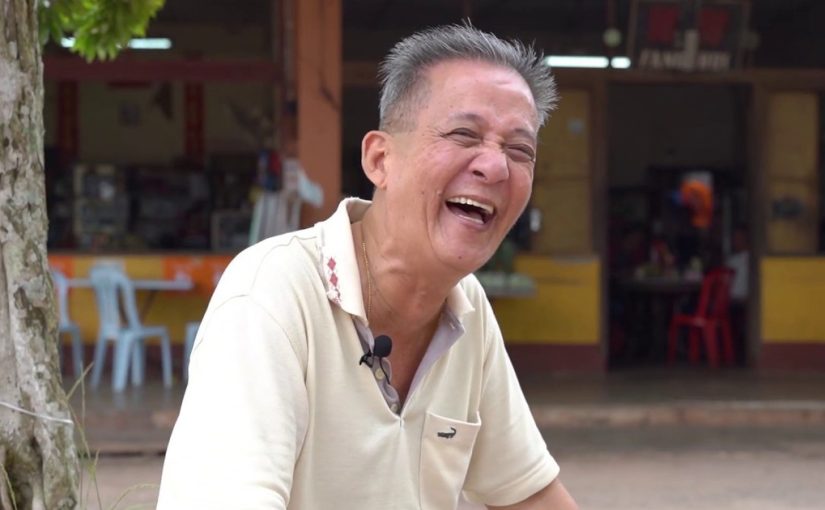
Early in the morning, when moist fogs still permeate the air, the old house surrounded by tall and straight palm trees, 64-year-old Seah Tiam Chai sorts out his tools in front of the doorstep, packing them onto his motorcycle and rides to the small jetty nearby in preparation to go out to the sea for prawning. Dozens of small fishing boats are parked in the intertidal zone of the estuary, with mangrove forests all over, the rivershore is not deep, Mr Seah races against time to steer his boat out of the estuary before the tide ebbs. As a layer of golden rays pop up from the horizon, and the sky gradually brightens, the motor of the boat is already ignited, sailing towards the unpredictable sea.

Since his childhood years, Mr Seah has a close relationship with the sea, accompanying his elder brother in deep sea fishing at the age of 10, picking up fishing skills and knowledge from his two elder brothers. When he was 13, he went out to sea alone in a sampan, without an engine in the olden days, rowing manually and cast a net to catch fish and prawns. Mr Seah is much experienced in sailing at sea, in his 50 years of fishing he used fishing nets of various sizes, catching different fishes according the different mesh sizes. In his youth he used to steer a fishing boat with medium horsepower, often witnessing and experiencing pirate attacks, being robbed off the fish that he worked hard to catch, the industry having a high degree of risk. Among all risks, natural hazards especially storms are beyond control.

The opposite shores invisible across the boundless blue sea, the five-metre long fishing boat seems extremely meagre, unable to withstand slightly stronger waves, even more at a loss against the sudden occurence of natural hazards. Any storms or strong waves cause direct harm to a fisherman’s production, and even life. Mr Seah’s fishing boat is not big, with sufficient room for three persons, with the addition of fishing tools and operation, the narrow boat has barely room for one to two persons to move about. Hence usually Mr Seah works alone, fishing at sea on his own.

After deciding on a suitable spot, he starts to cast prawning nets piece by piece into the sea. Twenty pieces of prawning nets forming into a fishing net, laying horizontal in the sea, the half-kilometre long shaped net drifting along with the tides, when fish and prawns pass through they will be caught in the mesh, this traditional and widely used fishing method is named: Gillnetting. Due to the fishing net being set up on the migration pathway of the schools of fish, catching them all regardless of size. An hour afterwards, Mr Seah draws up the net, keeping the prawns that are entangled on the mesh fresh by freezing them with ice, the rest of the fish will be further processed upon returning to the jetty.

Besides the unpredictable natural factors, industrial development in recent years brought upon environmental damage, endangering the fishing industry in Chuah area, especially with the construction of two power stations at the seaside. The lessening of mangrove forests and the changes in water quality caused reduction or damage to the natural habitat of prawns, directly impacting Mr Seah and his livelihood, the amount of his catch declined more than a half from usual. The fishing industry which faced higher risks than the general industries on the ground is dealt with a heavier blow.

The open-minded and optimistic Mr Seah does not wish for riches, nor did he encourage his children to work in the fishing industry. He leads a rustic life in the 50-year-old cottage which houses three generations, enjoying delightful family times with his wife and granddaughter.

Text: Daniel Lim & Pua Hui Wen

有你 UNI Production
Producer : Mok Yii Chek
Coordinator : Daniel Lim
Cinematographer : Amelia Lim /Evon Pang
Drone : Daniel Lim
Video Editor : Michael Lerk
Production Assistant : Michael Lerk
Music : Peder B. Helland – Our Journey from YouTube

COPYRIGHTS 2019 ECHINOIDEA SDN BHD

☕ Buy Us Coffee

The Ferryman

The Ferryman. Sailing on rivers, cruising across two shores, ferrying people across the Sepang river, handling a small ferry, closing the gap between two states, and ease countless passengers who cross the river. The Tang family has been operating at this jetty for three generations, never ceasing in maintaining this travel passage for inhabitants from these two shores.

The Sepang river flows between the states of Negeri Sembilan and Selangor, a work of nature separating two states. Not only is Sepang river the source of living for neighbouring villagers, it also bridges economical activity for residents from both ends. Transportation via water plays an important role, especially between Sungai Pelek located in the southeast part of Selangor and Bukit Pelanduk located at the northwest of Negeri Sembilan.

In the earlier days where land transportation were not developed, the inhabitants in the proximity are dependent on the boat service, where students go to school, housewives go shopping, farmers go to work, and more on. The scene back then was extremely busy, with plenty of boats crossing to and fro the river. In the golden era, there were plenty of boat and ferry services along the riverside, with some running their own independent business by building a simple jetty in their own territory. Since the traffic system connecting with the city were developed and roads were built, for now there is only one remaining ferry service.

The 63-year-old ferryman, who goes by Tang Kah Chai, navigates the small ferry skilfully over the shores of Negeri Sembilan (Bukit Pelanduk) and Selangor (Sungai Pelek) on a daily basis, fetching batches of passengers across the river. The family business is now in the third generation. During the Japanese occupation, Tang’s grandfather initiated the business with a small sampan rowed manually. It was hard work. In the recent decades, evolution of technology made life easier for boatmen and ferrymen, as the boats and ferries are powered by engine. This also boosted the safety of passengers, as well as increases the number of passengers each trip.

The river surface is about 150 metres wide, the trip across the shores only takes a couple of minutes, yet it employs the services of three generations of ferrymen for almost 80 years. They even earned the regard of the local community. A short encounter on the ferry daily makes passengers familiar with the ferryman, chit-chatting while on the ferry makes them more close knit, and illustrates a warm affection for each other.

Even though nowadays the traffic system is completed, the communion between Bukit Pelanduk and Sungai Pelek on the opposite side since settling in for half a century, where their living and economy has long been inseparable, however there is still no news about a bridge construction plan that the local residents were looking forward to for ages. The main communication and transport channels are travelling 20 minutes by land or two minutes by water.

Since ferries powered by engines replaced manual rowing, the tickets inflated from just a few cents to 50 cents. As the last ferryman in three generations of the Tang family, Tang Kah Chai remains committed steadfastly, crossing the river daily from early morning to the evening all year long.

For now, the two families of Tang and Chong taking turns weekly to be in charge of the jetty.

Text: Daniel Lim

有你 UNI Production
Producer : Mok Yii Chek
Coordinator : Daniel Lim
Cinematographer : Amelia Lim / Evon Pang
Drone : Daniel Lim
Video Editor : Evon Pang
Production Assistant : Michael Lerk
Music : Touching from Ashamaluev Music

COPYRIGHTS 2019 ECHINOIDEA SDN BHD

☕ Buy Us Coffee

Chuan Lee Chan

Wearing a protective eye mask, then simply wrapping the nose and mouth with a rag to block fumes and metal dust. These are the standard procedures practised daily by octogenarian Master Lim Chang Wan (transliteration). The blazing charcoal fire burns through the steel, turning it bright red. Striking while the iron is hot, husband and wife joined forces to pinch and hammer, cutting the steel bar into small pieces. After that, the steel is beaten into shape with the use of an air forging hammer and an iron hammer. The shaped steel is then returned to the fireplace to be burned until red. With the above steps repeated over and over again, only could the raw steel be shaped. The final step is quenching, which is air-hardening. Putting the red-hot steel into a liquid for immediate cooling can enhance the hardness and strength, this process puts the ironsmith’s skills to test.

Having almost 100 years of history, the blue single-storey antique wooden shop lot is covered beneath tree shades, nestled in the old streets of Pasir Penambang, is the iron shop Chuan Lee Chan. More than half of a century ago, Master Lim Chang Wan (transliteration) who was born in Klang relocated to Pasir Penambang with his family in 1952. His father who was also an ironsmith bought the shop, negotiated with the ex-shop owner to continue using his signboard, and started running his own iron shop. Lim Chang Wan (transliteration) and his elder brother followed in their father’s footsteps to manufacture knives since they were teenagers.

At the beginning stage, competition was intense, as knives are durable unlike daily supplies. The Lim siblings learned the forte from others in the industry to enhance their skills. Not only so, they also personally sell the knives they made to other areas, such as Sasaran, Kapar, Banting, and Tanjung Sepat. After decades of diligence and contribution, Chuan Lee Chan gained recognition around 1982, as word of mouth spread and customers came to purchase and place customised orders. As their business stabilised, they stopped selling knives in other areas.

As times moved on, the elderly Master Lim is still energetic and enthusiastic. Although he is downcast that traditional household ironsmith could not compete with industrialised manufacturers in terms of high production numbers and low costs, Master Lim enjoys forging knives as usual, and immerses himself in it, especially when receiving praise from the customers. Customers are willing to purchase a better quality knife at a higher price, especially plantation owners in the neighbouring areas. As the saying goes, “To work efficiently, your tools must be sharp”. The sharp and durable knives Master Lim manufactured not only helped increase productivity at the plantations, his ironsmith store earned a good reputation as well, in a win-win situation.

Master Lim has been working with knives for 65 years, and experienced the ups and downs in the ironsmith industry. Half-retiring, he no longer accepts large numbers of orders or large projects. He still operates on a daily basis, providing walk-in customers from all backgrounds knife sharpening and air-hardening services. He also sells a variety of knives sourced elsewhere. None of his three children were interested in taking up the labouring trade. The metal tools produced by hard labour of ironsmiths, the sounds of the hammer striking, and one by one the household iron shops may become obsolete, vanishing from sight.

The blue wooden shop lot underneath the trees’ shades, and the ’22’ mark on the knives, Lim Chang Wan (transliteration) has been hammering most of his life. 

Text: Daniel Lim & Pua Hui Wen

有你 UNI Production
Producer : Mok Yii Chek
Coordinator : Daniel Lim
Cinematographer : Amelia Lim / Evon Pang
Video Editor : Amelia Lim
Production Assistant : Michael Lerk
Music : Lightly Upon The Surface from Felt Music

COPYRIGHTS 2019 ECHINOIDEA SDN BHD

☕ Buy Us Coffee