Winson Burger

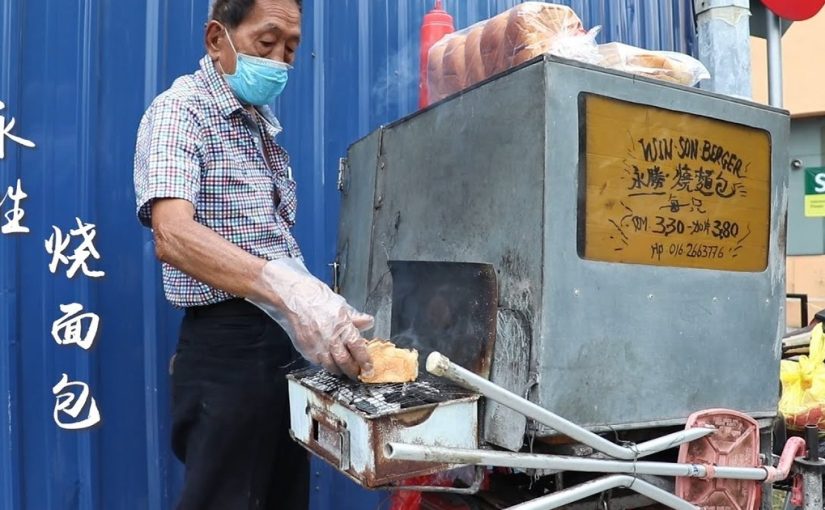
Around 7A.M., a figure could be seen riding an old motorcycle which bore a metal case, slowly heading towards the junction between Pudu Integrated Commercial Complex (ICC Pudu) and Pudu Plaza, the vehicle is then propped beside a lamppost. Uncle Chai Tsim Luk opens the metal case and starts prepping the fresh ingredients purchased daily from the market: cutting sheets of meat jerky into strips, and topping up the empty container with meat floss. The charcoal inside the portable stove is already ignited, all the necessary preparations have been made. At 8A.M., Uncle Chai starts selling charcoal-grilled meat jerky and floss buns, till noon or sold out. 

Meat jerky and floss bun was a creative approach by meat jerky stores to promote consumption of meat jerky besides being a festive food during Chinese New Year. Affordable and tasty, substantial and convenient, meat jerky and floss bun was the hype of the 1960s and 70s. Hawkers seized the business opportunity and sprung up everywhere, popularizing the meat jerky and floss bun which then became a classic breakfast fare. 

Firstly, slice the bun horizontally, spread with butter, and grill until crispy and aromatic. Uncle Chai carefully trims the burnt bits away, and spreads more butter before adding fillings. He piles up the meat floss and a few cucumber slices, add a strip of jerky, and then squeeze some chilli sauce or ketchup based on customer preference. 

Uncle Chai hailed from Sentul, a born-and-bred KL-ite. During his youth, he worked as a movie projectionist, a deliveryman and various other jobs. In his hectic lifestyle, he fell in love with the common and affordable meat jerky and floss bun. He happened to make an acquaintance with a hawker whom he frequented, and started selling meat jerky and floss buns in the morning, after he finished his night shift at the cinema. When the cinema ceased operations, he became an itinerant hawker, with flexible work hours and locations. He works if the weather permits, and rests when it rains. 

The eye-catching yellow signboard is handwritten by Uncle Chai himself, who acquired a bold calligraphy style from decades of writing movie flyers at the cinema. Since the British colonization era, Malaysians have started to adopt English names. Uncle Chai took a liking to the name ‘Winson’, transliterating it into ‘everlasting victory’ in Chinese, also containing good hopes for his enterprise. In his younger days, he went around crowded places, such as housing areas in Cheras, Bukit Bintang, and Chow Kit road. As he grew frailer with age, he chose to set up a stall in a fixed spot at Imbi wet market, now relocated to ICC Pudu. 

Uncle Chai believes that good grooming is courtesy to others, therefore he always keeps up a neat and clean appearance. Sporting a short-sleeved shirt, trousers, and black leather shoes, he appears to be full of spirit despite being over 80 years old. Uncle Chai thoroughly enjoys his job, as working hours are short, and no abusive scolding by superiors involved. Over the past 40 years, most of his fellow hawkers either changed jobs or switched to using gas stoves, yet he sticks to using a cumbersome charcoal stove to maintain the authentic flavour. Even though ingredient costs continue to hike, he only implemented slight price increases. Now that fellow hawkers are selling at RM4 to RM5 per piece, Uncle Chai sells at RM3.30, the portions remain generous. A single man, he only needs to generate sufficient income to sustain himself, without having to worry about feeding a family.

Pursuing his passion for a career, Uncle Chai retains an upbeat attitude and enjoys an ordinary life. An old motorcycle and a custom-made metal case keeps him company in making ends meet. He is satisfied with what he has, and is honest and kind, reaping a comfortable lifestyle. 

有你 UNI Production
Producer : Daniel Lim
Cinematographer : Amelia Lim / Evon Pang / Michael Lerk
Drone : Daniel Lim
Video Editor : Michael Lerk
Copywriter : Pua Hui Wen
音乐 Music : 《Nature》

COPYRIGHTS 2021 ECHINOIDEA SDN BHD

☕ Buy Us Coffee

Hainanese Boiled Duck

In a corner of the light and bright kitchen, red-hot charcoal burning in the cement stove turns into gray ash. A free-range duck, cleaned thoroughly, with its feathers all plucked and entails removed, is trussed and ready to be cooked. As the water in the cast iron wok boils, an hour-long hot bath awaits the duck, after which the Hainanese boiled duck is born.

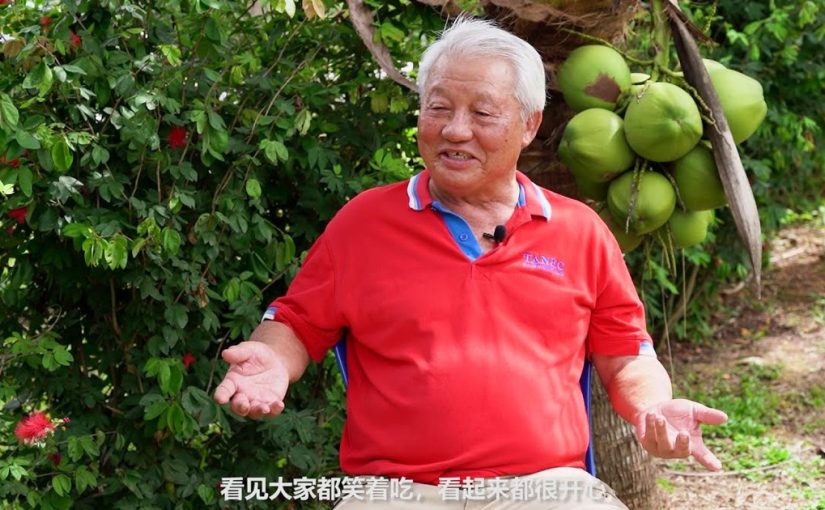
Pang Yok Sin, one of the school directors of Port Dickson Chung Hua High School, is sweating profusely while cooking, busy controlling the temperature of the charcoal stove and the doneness of the food, with assistance from his wife. After soaking the duck in boiling water, rotating it at intervals while pouring boiling water over its flesh to ensure even heating and doneness, the cooked duck is removed from heat to cool before being cut up and served. The remaining soup stock is the essence of the duck, and can be used to cook fragrance duck rice, blanch vegetables, make essential condiments, or even cook zucchini soup. Uncle Pang and wife conjure up a tableful of authentic Hainanese dishes while demonstrating the virtue of thrift.

The specialty of Hainanese dishes focus on fresh ingredients and their original tastes. The four classic dishes being: WénChāng chicken, JiāJī duck, DōngShān mutton, and HéLè crab; all were named after their cities of origin. Among them, the traditional way of preparing WénChāng chicken and JiāJī duck is by boiling, to preserve the tender meat texture of poultry. During the global mass migration in the 20th century, many Hainanese forefathers settled down in Malaysia, simple Hainanese dishes such as boiled chicken and chicken rice became popular. However, authentic Hainanese boiled duck and duck rice balls are rarely found in local restaurants. Uncle Pang is only able to savour these upon visiting his eldest brother or paying respects to his ancestors in QióngHǎi city.

Boiled duck is easy to cook, the challenge lies in seeking a suitable duck. JiāJī duck, commonly known as “foreign” or mule duck, is a hybrid of muscovy and common duck, and the breed was said to be brought in from Malaysia to JiāJī town in QióngHǎi city some 300 years ago. The features of mule ducks are a stout body and shanks, with white and black feathers which are extra long at the wings and tail. Mule ducks are allowed free range for two months, and then force-fed for a month. Therefore the duck has thin skin and soft bones, its meat high in protein but low in fat, best boiled to showcase the tender texture. The Malaysian government discourages home poultry breeding due to hygiene reasons, yet the duck available in supermarkets are unpalatable, so mule ducks are hard to come by.

With great difficulty to secure a suitable duck, Uncle Pang endeavoured to retain the natural taste of the duck. Firstly, clean the duck of feathers and entrails, rub it over with salt and flour, then blanch it. Prior to boiling, the duck is stuffed with equal portions of ginger, garlic, and shallots mixed with salt. It is then trussed to ease rotating. Controlling the charcoal stove temperature at a simmer requires patience and skills, so that the duck is cooked evenly. The remaining ginger, garlic, and shallots are then stir-fried, drizzled with the rich duck stock, enhancing flavours by adding lime, vinegar, or chilli. Such is the preparation of condiments to complement the dish.

Even though it has been decades since Uncle Pang last cooked this traditional dish, the steps are deeply ingrained in his mind, particularly the charcoal stove brought back fond childhood memories of cooking together with his parents and siblings. The open kitchen doubles as a dining hall where the entire family gather happily. Zucchini is planted in the backyard, easily available to be plucked and cooked into soup whenever the family is having boiled duck, the succulent zucchini is packed with yummy duck aroma.

The simple yet delicious boiled duck and various derivative dishes reflect the strong emotional bonds in Hainanese dishes. The elder generations taste familial attachment, while the younger generations chew upon cultural heritage. Uncle Pang who is of advanced age, not only took pleasure in cooking, but also proactively promotes traditional native cuisine.

Text: Daniel Lim & Pua Hui Wen

有你 UNI Production
Producer : Mok Yii Chek
Coordinator : Daniel Lim
Cinematographer : Amelia Lim / Evon Pang
Video Editor : Amelia Lim
Production Assistant : Michael Lerk
Music : The Romantic

COPYRIGHTS 2020 ECHINOIDEA SDN BHD

☕ Buy Us Coffee

Hokkien Khún Miên/Mī

Long and thin yellow noodles coiled into palm-sized flat discs on a bamboo sieve, is an authentic Hokkien dish——Khún Mī, also known as “Khún Miên” or coiled noodles. It has a springy but not sticky texture, usually best consumed alongside dishes with rich sauces, such as braised pork knuckle, sea cucumber pork stew, or bak kut teh. The way of eating may vary, some like to twist pieces off similar to eating bread, whereas others would cut into small pieces and pick up with chopsticks. Khún Mī is not greasy due to no oil used during its production, pure original noodle flavours can be savoured upon each bite.

Consuming noodles on birthdays imply longevity, therefore in Hokkien food culture, noodles are of great consequence. Noodles are also a must-have in worshipping deities and ancestors. Khún Mī stands out from the rest due to its circular shape symbolizing completeness, as well as its excellent shelf life, since it does not turn sour or spoil easily after being laid out for a few hours in the warm and humid climate of Malaysia. Moreover, dishes paired with Khún Mī bear good significance, for instance pork knuckle means improvement, sea cucumber means endless opportunities, indirectly establishing Khún Mī’s sublimity in the Hokkien society.

Elders who moved abroad in the early days are more familiar with this native dish, popular with homesick migrants. As they settled down in Malaysia, Khún Mī evolved into a common economical food. Eventually the older generation passed away, the younger generations who did not have fond attachments stopped producing the time-consuming and laborious Khún Mī, as they regarded efficiency to keep up with modern lifestyles. Khún Mī became increasingly rare, mostly sought after by Hokkiens for the Jade Emperor’s birthday celebration and Hungry Ghosts festival. Youngsters nowadays may not have heard about Khún Mī, but only yellow noodles which are almost identical.

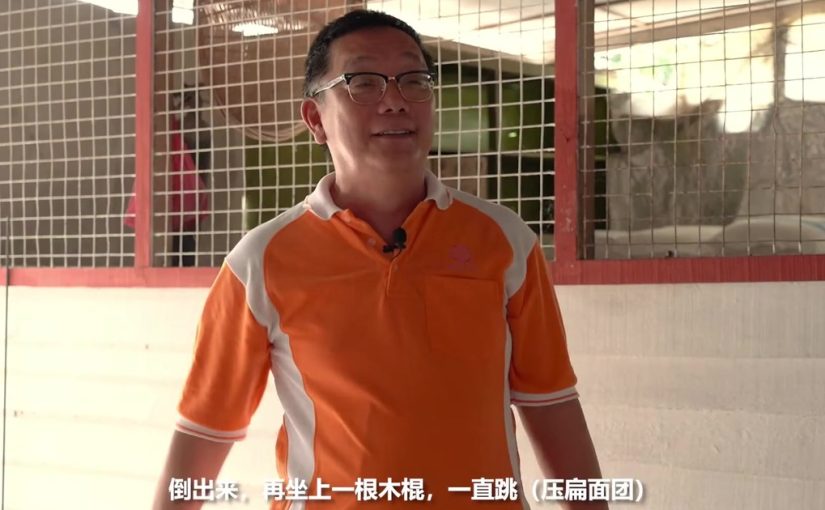
In Kuala Pilah located in the mid-section of Negeri Sembilan, the sole remaining family-run noodles workshop lies behind the slope of the hawker centre, specializing in producing and supplying traditional Hokkien noodles including yellow noodles and Khún Mī. The both are basically the same, the only difference being Khún Mī is oil-free and has a pleasing visual. Khún Mī is toilsome to make, requiring delicate handiwork and involves more manpower. Firstly, cut out noodle strips two feet in length, then hang onto a rattan hoop and spread out gently. During the blanching process, it is important to note the temperature, as overcooking may cause breakage. The cooked noodles are submerged in cold water for al dente consistency, then one person sorts them into clusters of 4-5 strips, and another coil them up on a bamboo sieve.

With almost 40 years experience in manufacturing noodles, Uncle Lim Sze Hock, nicknamed “Noodle-seller Hock”, is the third generation successor of this family-run workshop. His grandfather set up the workshop and engaged chefs from EngChoon, China to teach the skills. Uncle Lim’s mother, octogenarian Madam Khoo Yeoh, has been involved in making noodles since she married into the family at 23 years old. Before there was pipe water supply, she had to draw water from a nearby well. During their childhood, Uncle Lim and his siblings used to sell noodles after school. He had a job in Kuala Lumpur before returning to take over the workshop in the event of his father’s sudden death.

The procedures of noodle manufacturing are not too complicated, compared to the earlier days when kneading is done by hand, the mixture rolled by a wooden pole, and the noodles shredded using knives. Now there is a semi-automatic production line, a diesel stove replaced the woodfire stove for blanching. Even so, the job is deemed less profitable, Madam Khoo discouraged her grandchildren to inherit. In the past there were four such workshops in Kuala Pilah, however they all closed down due to lack of heir. Luckily when Uncle Lim decided to retire, his youngest brother Lim Sze Hian would like to carry on the family business, Khún Mī is still available locally.

Traditional heritage food depends on geographical area and lifestyle practices. Due to globalization and the increasing pace of life, traditional food culture is phasing out. There might still be Khún Mī in Klang, Melaka, or Penang with a majority Hokkien population, however not many people understood its implication.

Text: Daniel Lim & Pua Hui Wen

有你 UNI Production
Producer : Mok Yii Chek
Coordinator : Daniel Lim
Cinematographer : Amelia Lim / Evon Pang
Video Editor : Michael Lerk
Production Assistant : Michael Lerk
Music : Ukulele In Town

COPYRIGHTS 2020 ECHINOIDEA SDN BHD

☕ Buy Us Coffee